
Journal
The Balancing Toy That Teaches Physics (Without a Screen)
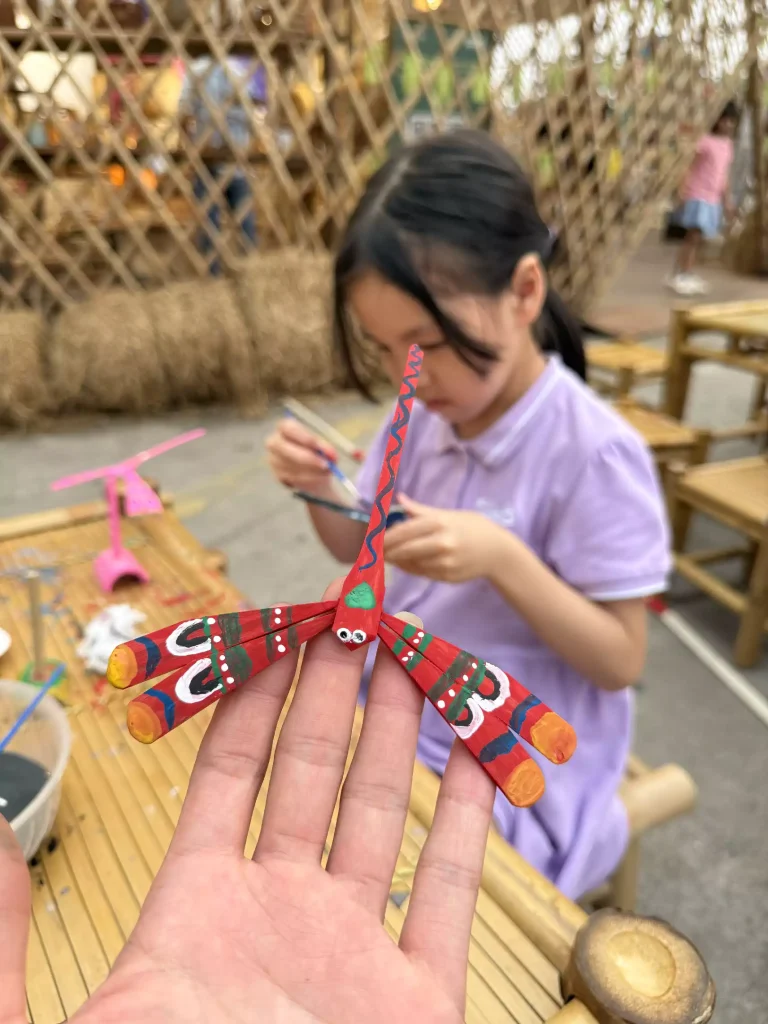
Jul
Hand a child a bamboo dragonfly and say nothing. They will set it on a fingertip, feel it hold, and ask the only question that matters: why doesn’t it fall? That question — asked freely, not assigned — is where physics teaching actually begins.
A balancing bamboo dragonfly is a centre-of-gravity lesson disguised as a toy. No batteries, no app, no instructions to lose. Here is how parents and teachers use ours.
The physics, in one breath
The dragonfly’s weight is concentrated in its forewings, which sweep forward of the beak. That places the centre of gravity directly below the point where the beak rests — and an object supported above its centre of gravity settles back to level instead of tipping. Nudge the tail and it swings home. We unpack the whole idea in how a bamboo dragonfly balances.
Three activities that teach it by hand
1. The balance hunt (ages 5–8)
Before the dragonfly comes out, hunt for the balance point of ordinary things: a ruler on a finger, a spoon on the table edge, a broom across one hand. Then present the dragonfly — balanced not in the middle, but on its nose. Let them sit with how strange that is. The strangeness is the lesson.
2. Paint, weigh, re-tune (ages 8–12)
Start with an unpainted set. Balance each piece first, then paint. A heavy coat on the tail shifts the centre of gravity — suddenly the dragonfly leans. Ask why. Then show them how to re-tune it with nothing but their fingers. Mass, position, correction: an experiment they can feel.
3. Predict and test (ages 12–15)
Set a dragonfly on a fingertip, a pencil tip, the rim of a glass. Before each move, have them predict: balance or fall? Then the harder question — design a flyer of your own from card and paperclips that balances on its nose. Most first attempts fail, and every failure points back at the same principle.
Why bamboo beats a boxed STEM kit
A plastic kit teaches its lesson once, then rattles in a cupboard. A hand-tuned bamboo dragonfly keeps working after the lesson — as decor, as a desk companion, as the thing a child shows every visitor for a year. It is also compostable at the end of a long life, which is its own quiet physics lesson: everything goes somewhere.
For classrooms
Our dragonflies come in painted and unpainted sets of ten — one set covers a table group, three cover most classes, and the unpainted set doubles as the art lesson. Teachers write to us often; if you are planning a unit, we are happy to help you plan quantities.
Every dragonfly is tuned by hand at the Liên Xoan atelier in Thạch Xá, Hanoi — where the physics has been understood by feel for twenty-five years.
