
Journal
How to re-tune a bamboo dragonfly
Apr
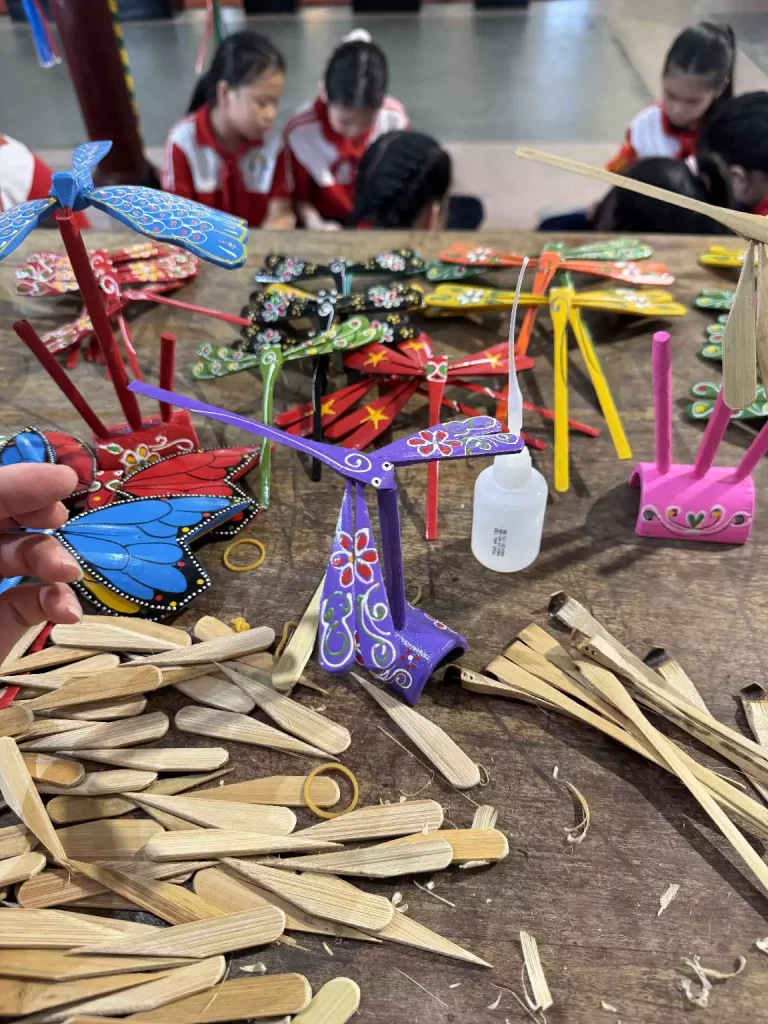
A bamboo dragonfly that has travelled a long way sometimes arrives slightly out of tune. It leans forward. It tips to one side. It no longer rests, perfectly still, on a fingertip. This is not a defect. It is a small, fixable consequence of a handmade object made in one climate and delivered to another. Most re-tuning happens in under a minute. The dragonfly was designed to be tuned by hand — including yours.
Why a dragonfly loses its balance
Three things change the balance. Humidity is the most common — bamboo absorbs water from the air, and when one wing absorbs a little more than the other, the piece tilts toward the heavier side. Impact is the second — a bump in transit can bend a wingtip by a millimetre, which is enough to throw the tuning. Time is the third — over years, bamboo settles into its own weight, and a piece that was perfectly tuned twenty years ago may want a small adjustment today.
All three of these changes are minor, and all three respond to the same small intervention: a gentle bend of a wingtip or the tail, by hand, followed by a re-test.
Before you touch anything, diagnose
Set the beak of the dragonfly on the tip of a chopstick, a pencil, or a fingertip. Watch which way it tips, and make a mental note.
- Tips forward (beak down, tail up) — too much weight in front. The fix is in the tail.
- Tips backward (beak up, tail down) — too much weight behind. The fix is in the tail.
- Rolls left or right (one wing drops) — uneven wings. The fix is in the lower wing.
- Will not rest at all (flops off in any direction) — usually a combination of the above; re-tune one axis at a time.
The four-step re-tune
The principle is the same one Liên uses at the atelier. Adjust one thing, test, adjust again if needed. Do not try to correct forward-tipping and left-roll in one motion; you will over-correct and lose the fix. One axis at a time is always faster in the end.
You do not need a workshop. A chopstick, a flat surface, and a good light are all the tools required.
Step 1 — Tail adjustment (forward/back tilt). If the dragonfly tips forward, gently bend the tail down — one or two millimetres is usually enough. If it tips backward, bend the tail up. Hold the tail at its base with one hand and make the bend toward the tip; the bamboo is supple enough to take a small curve without cracking. Re-test on the chopstick.
Step 2 — Wing adjustment (left/right roll). If the dragonfly rolls to one side, the heavier wing is dipping. Gently bend the tip of the lower wing upward — one or two millimetres. This shifts a small amount of weight back toward the centre. Alternatively, bend the tip of the higher wing downward by the same amount; either direction works, but only correct one wing, not both. Re-test.
Step 3 — Beak check. If the beak has been bumped in transit, it may now be slightly flatter or sharper than it was. A flatter beak tends to skid off the pivot; a sharper beak tends to balance even better. If you see a visibly straightened beak, the fix is to restore the small upward curve — press the beak gently between thumb and forefinger until the curve returns. Do not use heat at home; room-temperature bending is enough for minor corrections.
Step 4 — Final balance test. Rest the dragonfly on the chopstick one more time. Tap one wing lightly with a fingertip. It should nod, hold, and settle. If it spins off, return to step 1 and look for the smaller residual tilt.
Rules that prevent mistakes
Small moves, many tests. Every adjustment should be one or two millimetres. If you bend a wing five millimetres, you have created a new problem. The atelier’s own rule — less than you think, more often than you would expect — applies at home too.
Work slowly. Give the bamboo a moment to register each bend. Plastic springs back immediately; bamboo takes a second. Re-test after a short pause rather than immediately.
Bend, do not flex. A slow, steady pressure along the length of a wing or the tail produces a clean curve. A quick flex with the tip of a finger puts stress on a single point and can leave a hairline crack — invisible, but permanent.
Use a chopstick, not a fingertip, for testing. Your finger is an unstable platform — it sways slightly with your breath. A chopstick laid flat on a table is a fixed pivot and will tell you what the dragonfly is actually doing.
A humid-day tune versus a dry-day tune
In countries with distinct seasons, some owners notice their dragonfly behaves differently in summer than in winter. This is the humidity. Bamboo that has taken on a little summer moisture holds a different balance from the same piece after three weeks of central heating. The fix is the same four-step tune above. The only caution: a dragonfly tuned on a very damp day will come back slightly forward when the air dries. Tune on an average day if you can, and the piece will behave well across the year.
When to leave it alone
Some residual movement is normal. A dragonfly that settles after a small rock is doing exactly what a stable-equilibrium object is supposed to do — the physics is explained here. If the piece rests, tilts briefly when tapped, and returns on its own, do not re-tune it. You will over-correct.
If it will not balance at all
In the rare case that a dragonfly refuses to balance after careful re-tuning, the issue is usually a cracked wing — often a hairline fracture invisible to the eye but detectable by pressing a wing at each end with a fingernail. If the bamboo yields at one spot more than the others, the crack is there. At that point, the atelier will repair or replace the piece; write to us with a photo and a brief description and we will arrange it.
The quiet satisfaction of a re-tuned piece
There is a small satisfaction in re-tuning a dragonfly by hand — the same satisfaction, in miniature, that Liên has every time he takes a piece off the bench. The object is no longer finished and then static; it is a thing that responds to adjustment, that can be brought back into balance, that lives a little. For the cost of a minute’s attention, the dragonfly sits still again. That is the whole trick of the craft.
If you need a fresh one or a replacement, the shop ships directly from the village, and every piece is tuned at the atelier before it leaves.
Background reading: the physics of why it balances in the first place, and our shipping notes — including what to expect if a piece arrives slightly out of tune.
Frequently asked questions
Why has my bamboo dragonfly stopped balancing?
Three common causes: humidity (bamboo absorbs moisture and wing weight shifts), a small knock that bent a wing, or the beak tip getting dented. All three are reversible with a 2 to 5 minute re-tune.
How do I re-tune a bamboo dragonfly at home?
Set the beak on your fingertip. Note which side it tips toward. Gently bend the opposite wing downward in 1 to 2 mm increments until the piece settles. If it rocks without falling, stop — that is tuned.
Can I re-tune a bamboo dragonfly with a damaged wing?
Yes, as long as the wing is bent, not broken. Crease lines are fixable by gentle back-bending between the fingertips. A cleanly snapped wing needs a replacement piece — contact the atelier.
How often does a bamboo dragonfly need re-tuning?
In a stable indoor climate, almost never. In a humid tropical climate or after travel in a suitcase, expect to re-tune once every few months. The process takes under five minutes once you know the feel.
