
Journal
The Balancing Bamboo Dragonfly: How It Defies Gravity
Apr
It sits on its beak.
Not on a stand, not on a wire. On the point of its own painted beak, on a fingertip, on the rim of a teacup, on the edge of a book. Tap the wing and it rocks — then settles, every time, back to exactly where it was. There are no magnets in the body and no weights hidden in the tail. There is only the geometry of how the wings are set, and the patience of the hand that tuned them.
This is the chuồn chuồn tre of Thạch Xá village — the balancing bamboo dragonfly that has been made, by hand, in a small cluster of workshops west of Hanoi since the early 2000s. It has travelled from a souvenir sold at the base of a pagoda to a desk piece that sits on bookshelves from Tokyo to Berlin. This is the story of how it balances, who makes it, and where it comes from.
What is a balancing bamboo dragonfly?
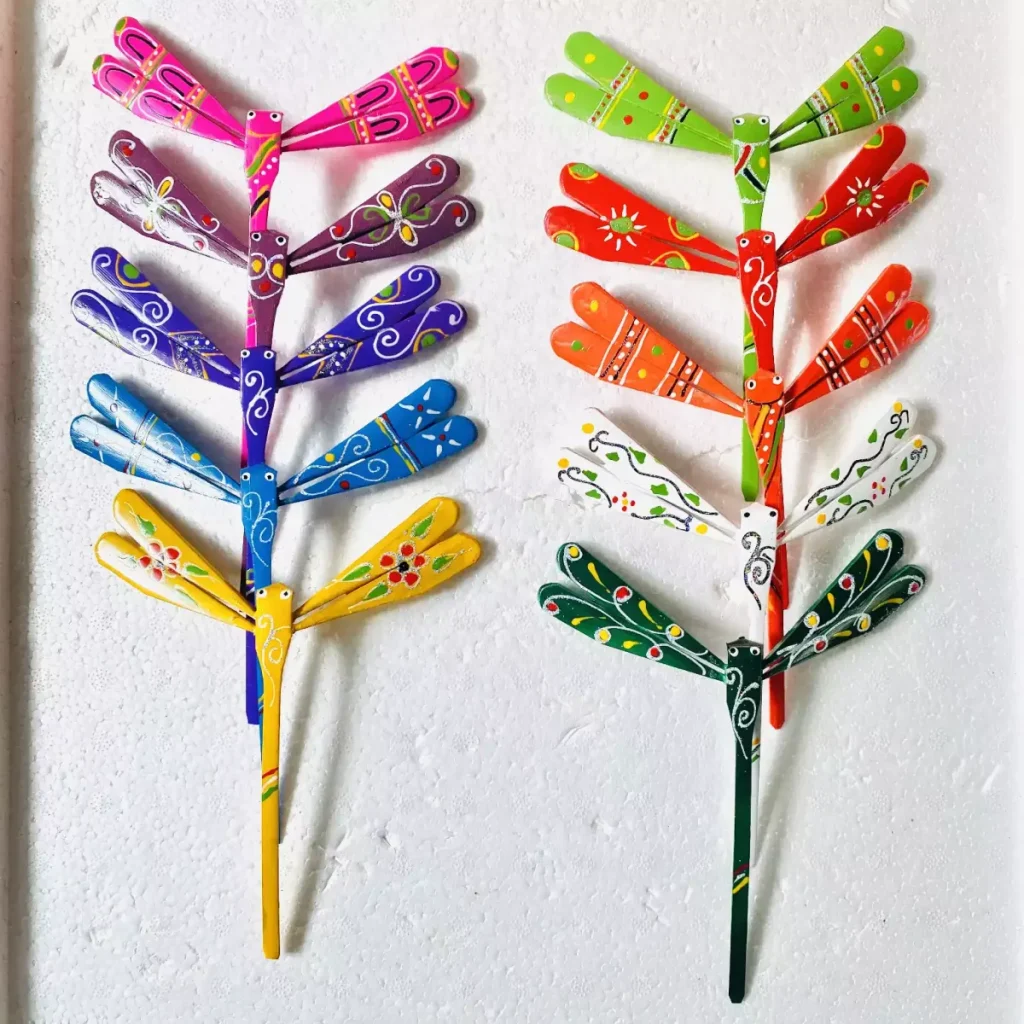
A chuồn chuồn tre is a dragonfly carved from split bamboo and tuned, by feel, to perch on a single point of contact. The body is a straight bamboo stalk shaped to a painted head; two forward-swept wings are fixed at the shoulder; a long, narrow tail runs to the tip. Every proportion matters. Cut the wings a fraction too wide and the piece tips backwards. A fraction too narrow, and it tips forward. The finished dragonfly is balanced not by measurement but by the maker’s own hand.
Thạch Xá is the craft’s spiritual home. The village makes them year-round, by the thousand, for homes and shelves and schoolrooms on six continents.
Where it comes from: Thạch Xá, at the foot of Tây Phương Pagoda
Thạch Xá is a small commune in Thạch Thất district, about forty kilometres west of central Hanoi. It sits in a region known historically as Xứ Đoài — the old quarter of the west — where craft villages cluster so tightly that each has a speciality of its own. A few kilometres away, Bình Phú has woven bamboo and rattan for generations; its baskets and trays travel to Japan, Korea, and Europe. Chàng Sơn, closer still, carves wood — mortise-and-tenon furniture assembled without a single nail, a tradition mentioned in Nguyễn Trãi’s Dư địa chí as far back as the fifteenth century. Thạch Xá, smaller, sits between them. Its own craft is younger.
Above the village stands Tây Phương Pagoda. The temple, raised on a low hill called Câu Lâu, is a national special heritage site; its eighteen Arhat statues are Vietnamese national treasures, and in 2022 the pagoda was officially designated a National Tourist Attraction. For centuries, visitors have climbed a narrow stone staircase to sit among the statues. The dragonfly craft was born at the bottom of that staircase.
Around the year 2000, a few families in Thạch Xá began selling small bamboo toys to the tourists walking up toward the pagoda. One of them — Nguyễn Thị Xoan — began making bamboo dragonflies that would balance on a string, or on a fingertip, for the visitors. Her husband, Đỗ Văn Liên, worked beside her; together they founded what is now the Liên Xoan atelier, the oldest dedicated dragonfly workshop in the village.
The first dragonfly took a long time. There was no manual and no master to copy; the geometry had to be worked out by trial. Each adjustment to a wing changed the balance, and the balance had to be right before the piece was worth selling. Once they had found it, they made it again, and again, and again. Tourists returning from the pagoda noticed the toys, bought them, carried them home. Word spread. Other households in the village began making them. Twenty-plus years later, roughly ten workshops in Thạch Xá still turn them out by hand — and Liên Xoan is one of the original ones, still run by the couple whose names are on the door.
The physics: why it balances
The explanation is simpler than it looks. Every object has a centre of mass — the single point where its weight is, in effect, concentrated. A pencil balanced on a fingertip is unstable because its centre of mass sits above the fingertip: the slightest tilt moves the mass sideways, and gravity pulls the pencil over.
The balancing bamboo dragonfly is different. Its wings are swept forward and curved slightly down. The tail, running backwards from the body, acts as a counterweight. When the piece is balanced on the tip of its beak, the forward sweep of the wings and the backward pull of the tail together drop the centre of mass below the beak — below the pivot point. Once the centre of mass is below the pivot, the dragonfly behaves like a pendulum: tilt it, and the mass swings back toward the lowest position, which is upright. It is, in physics terms, in stable equilibrium.
That is why no two dragonflies are tuned the same way. Bamboo is not uniform. One culm may be denser than another; one wing cut from a heavier section will need a slightly narrower opposite wing to balance. The makers do not measure. They cut, they feel the weight move in the hand, they trim a millimetre, and they feel again. A piece is finished when the hand stops adjusting.
How one is made
From raw bamboo to finished dragonfly, a single piece goes through roughly twenty steps. None are automated.
The bamboo itself — usually a small, straight-grained culm from the mountains of northern Vietnam — is split by hand. The splits are dried, sanded smooth, and sorted by thickness. A good maker can tell by weight alone which split will become a body and which a wing. The body is cut to length and tapered to a point at the beak. The beak itself is shaped by holding the bamboo against a hot iron rod — heat softens the fibre, and a short press gives the small upward bend that becomes the mouth and the pivot surface.
Wings come next. Each pair is cut from a single length, so the grain matches. They are shaped with a knife, smoothed, and fitted to a shallow notch in the body where they are pinned in place. The tail is set into the rear socket. The dragonfly is, at this stage, a pale yellow thing, featureless — the bamboo before it has been tuned.
Tuning is the step that turns a toy into a dragonfly. The maker holds the piece on the tip of a finger, or on a string, and watches it fall. One wing is too heavy, or the sweep is slightly off, or the tail is a fraction too long. A small blade takes off a shaving here; a touch of sandpaper, there. The piece is tested again. The cycle runs until the dragonfly sits still.
Only then does it go to the painter. At Liên Xoan, the painting is almost always Xoan’s side of the bench. She works with small brushes and an open tray of colours, and she paints one dragonfly at a time. Every piece is a little different. A simple dragonfly takes about twenty minutes from raw split to painted finish; an elaborate one, close to a full day.
Nothing in this process uses plastic, glue substitutes, or machinery. The dragonfly is entirely bamboo, entirely manual, entirely handmade.
The atelier: Liên & Xoan
Đỗ Văn Liên and Nguyễn Thị Xoan — Liên and Xoan — are a husband-and-wife workshop. Liên handles bamboo selection, structure, and tuning; Xoan handles the painting. They have worked this way for more than two decades. Their children help too, now, as the next generation learns the craft that their parents invented by hand.
A typical week at the atelier turns out several hundred finished dragonflies. The bulk of them travel abroad — to resellers in Japan and Korea, to independent gift shops in Europe and North America, and, increasingly, directly to customers who write to the workshop and ask for a particular colour or a particular name painted on a wing. The atelier keeps its prices low enough that a dragonfly remains a dragonfly — not a luxury object, just a small, beautifully made thing, the kind a child can hold and a grandmother can smile at.
Ask Liên what makes a good dragonfly and he will not talk about technique. He will pick up a piece, balance it on a finger, and say: if you cannot do this, it is not finished.
The range: what the atelier makes
The workshop carries several lines:
- Natural bamboo dragonflies — unpainted, letting the grain show, simple and spare.
- Painted dragonflies — the traditional form, with hand-painted wings in folk motifs; single pieces or sets of three.
- Personalised pieces — a name, a date, or a short message hand-painted onto the wing or the body.
- Bamboo butterflies — the same geometry and the same balance, but with a broader wing; a sibling of the dragonfly, carved on the same bench.
- Buffalo horn keychains — carved by the same family from a different material; owls, fish, and other small charms.
The shop carries all of these, organised by kind, with photographs shot inside the atelier itself. If you are new to the craft, the bamboo collection is where most people begin.
Not to be confused with…
Two other toys commonly surface in search results for bamboo dragonfly — worth naming briefly so the distinction is clear.
The bamboo-copter — Japanese taketombo, literally “bamboo dragonfly” — is a spinning flying toy, a small propeller on a stick that lifts into the air when spun between the palms. The mechanism is aerodynamic, not gravitational, and the toy does not balance. It is unrelated to the Vietnamese craft.
The Western balancing bird toy — a plastic or cardboard bird with weighted wingtips, sold in science-kit shops — uses the same physical principle as our dragonfly, but is mass-produced and has no cultural heritage. The Thạch Xá dragonfly is its handmade, bamboo, named-maker cousin.
Why people keep them
A balancing dragonfly is not quite a toy and not quite a sculpture. It is an object that rewards handling. It moves when you walk past it. It is excellent, unexpectedly, as a physics demonstration — a classroom-ready illustration of stable equilibrium that children can balance themselves. It sits well on a bookshelf and better on a desk. Many of our customers buy one, then come back for a second, then a third.
Some keep them indefinitely, and write to the workshop when the balance slips — usually because the piece has been knocked, or the wings have absorbed moisture in a humid season. We will, in that case, tune it again, or send a replacement. A good dragonfly outlasts its first owner.
Caring for a bamboo dragonfly: FAQ
How do I make it balance again?
If a dragonfly has lost its balance, the usual cause is a small knock that shifted a wing. Hold it on a fingertip and note which way it falls. Sand a sliver from the heavier wing, retest, and repeat. Restore in three or four passes.
Is it safe for children?
Yes, for children old enough to hold it. No small parts, no sharp edges once painted. The bamboo is smooth and untreated.
How should I store it?
Indoors, out of direct sun, and away from damp. Bamboo absorbs moisture over time; the balance stays truer in a dry room.
Where is the balance point?
The tip of the beak. Every piece is tuned to that single point of contact.
The dragonfly is still being made — one at a time
Ten households in Thạch Xá still make them, by hand, on benches their parents worked at. We are one of those ten. We post a piece out of the atelier when someone writes and asks for one, and we tune every one of them before it leaves the village. More on the atelier and how we work.
Further reading
Each of these follows one thread of the story above in more depth.
The village & the atelier
- Thạch Xá: the craft village at the foot of Tây Phương Pagoda
- Inside the Liên Xoan atelier — meet Đỗ Văn Liên and Nguyễn Thị Xoan
- Tây Phương Pagoda, the temple above the village
- Visit the atelier — a half-day workshop near Hanoi
- Twenty-five years at the bamboo dragonfly bench
How it’s made & how it balances
- The physics: how a bamboo dragonfly balances
- Why tuning one takes twenty minutes — the full process
- How to re-tune a bamboo dragonfly at home
Choosing & living with one
- Painted vs natural bamboo dragonflies: which to choose
- Personalised dragonflies — a name or date on the wing
- Five ways to display a bamboo dragonfly at home
- Handmade gifts from Vietnam under $30
- Shipping a bamboo dragonfly overseas
Culture & folklore
- Bamboo dragonfly meaning — Vietnamese folklore and symbolism
- Bamboo in Vietnamese culture — a thousand uses
Shop the collection → Read the journal
