
Journal
Thạch Xá: a craft village at the foot of Tây Phương Pagoda
Apr
Thạch Xá is an easy drive from Hanoi — about forty kilometres west, past rice fields that turn glassy after rain, toward the low hills around Tây Phương. At the end of the road sits Tây Phương Pagoda, a wooden temple perched on the shoulder of a small mountain. The village lies just below it.
This is craft country. Thạch Xá belongs to a region known historically as Xứ Đoài — the old quarter of the west — a belt of villages where, for centuries, each community has quietly specialised in one thing and passed it from one generation to the next. Walk any of its lanes and you will see bamboo drying against a wall, a pile of lacquered boxes at a doorway, a bicycle loaded with long poles. The workshops are small and the trades are old.
The neighbours: Bình Phú and Chàng Sơn
A few kilometres from Thạch Xá, in the same commune of Thạch Thất, two older craft villages set the tone. Bình Phú has woven bamboo and rattan for generations; its baskets, mats, and trays are exported to Japan, Korea, and Europe, and its co-operatives hold some of the region’s OCOP craft certifications. Chàng Sơn, closer still, carves wood — mortise-and-tenon furniture assembled without a single nail, a tradition mentioned in Nguyễn Trãi’s Dư địa chí as far back as the fifteenth century. Thạch Xá, smaller, sits between them. Its dragonfly trade is younger. But the bamboo knowledge around it is ancient.
Thạch Thất district as a whole counts around fifty craft villages and thousands of workshop households. A visitor who comes for the dragonflies will, almost by accident, drive past a dozen other specialities on the way.
Tây Phương Pagoda, above the village
Above Thạch Xá rises the hill of Câu Lâu, and on its shoulder sits Tây Phương Pagoda. The temple is a national special heritage site. Its eighteen Arhat statues, carved in dark wood and still bearing traces of their original colour, are recognised as Vietnamese national treasures. In 2022, the pagoda was designated an official National Tourist Attraction. Visitors climb a narrow stone staircase to reach it; on clear days, you can see the rice fields of Thạch Thất fan out below.
The pagoda is the reason the dragonfly craft exists. Around the year 2000, a young woman from the village, Nguyễn Thị Xoan, was selling small goods to the tourists coming up the hill. Somewhere along the way she picked up the idea of making a bamboo toy that would balance — and, after months of trial, made one. Tourists returning from the pagoda noticed the toys. They bought them, carried them home, told others. Word spread. Today, Xoan and her husband Đỗ Văn Liên run the oldest bamboo dragonfly workshop in the village.
Why bamboo
Bamboo is the material of northern Vietnam in the same way oak is the material of England or cedar the material of Japan. It grows fast, it splits straight, and it is light enough to balance. Generations of village craftsmen have worked it into everything from baskets and furniture to the small objects of a childhood — whistles, toys, and the dragonfly that rests on its beak.
The specific bamboo used in the dragonfly workshops is tre bánh tẻ — a middle-aged cut, neither young nor old, whose fibres are firm enough to hold a shape but pliable enough to bend under heat. Liên buys the culms in small bundles from mountain suppliers further north. The best weeks for cutting are cool and dry; green skin is stripped within a day, and the split strips are laid out in a breezy corner of the workshop to dry for several more.
The dragonfly, specifically
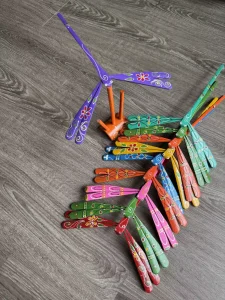
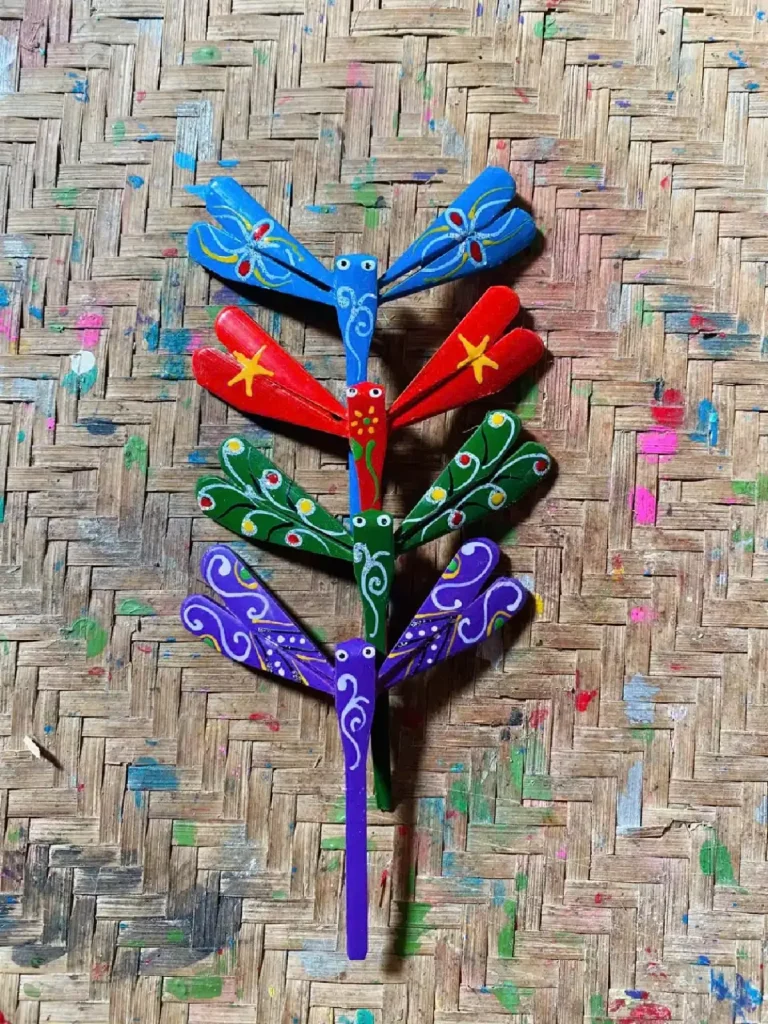
Thạch Xá has been making balancing bamboo dragonflies as a dedicated craft for more than twenty years. The design is deceptively simple: a body, two wings, a tail, a painted face. The difficulty is in the balance. Cut the wings a fraction too wide and the dragonfly tips backwards. A fraction too narrow, and it tips forward. The only way to find the right proportion is to hold the piece in your hand and feel the weight move.
Nothing in the process is automated. The bamboo is split by hand, shaped by hand, sanded by hand, painted by hand, and tuned — always, finally — by hand. A piece is not finished when it looks right. It is finished when it balances.
A few workshops, a few families
The village is small, and the number of households still making dragonflies at scale is smaller still. Ten or so workshops turn out the bulk of the village’s output — together, they ship roughly 20,000 dragonflies a month. Liên Xoan is the oldest of them — the workshop that helped set the craft’s quiet standard for the village — and Nguyễn Văn Tài, a neighbour, is another of the first-generation makers still at the bench today. Their dragonflies find their way onto bookshelves, teachers’ desks, and children’s windowsills across Japan, South Korea, the United States, Germany, France, and the United Kingdom.
Visiting the village
Thạch Xá is an easy day trip from Hanoi. A car or ride-hail from the old quarter takes about an hour in fair traffic; public buses from the city’s western bus terminals drop you within walking distance of the pagoda staircase. Most workshops welcome quiet visitors on weekdays, though it is always worth writing ahead — the bench is a working one, and a surprise visit on a busy export week is less comfortable for everyone. If you would like to try the craft yourself, the atelier runs short hands-on sessions on request.
Leave an hour for the pagoda at the top of the hill, and another for the lane of workshops below it. The best moment, for most visitors, is the one they do not plan for: a dragonfly, still wet with paint, balanced on the maker’s thumb.
We hope, in some small way, that every piece we send carries the village with it.
Read our story Shop the collection
You can also come and make one: we run a small bamboo dragonfly workshop in Hanoi in the village itself.
