
Journal
Painted vs natural bamboo dragonflies: which one to choose
Apr
At the atelier, the question comes up often. “Painted, or plain?” A customer stands in front of two shelves — one of dragonflies stripped back to the pale gold of raw bamboo, the other of pieces painted in the folk reds and indigos the village is known for — and is trying to decide which one to take home. Neither is the right answer. Both are. The honest difference is what they are for.
Two finishes, one dragonfly
Every balancing bamboo dragonfly begins the same way. The bamboo is selected, split, shaped, and assembled by hand. The dragonfly is tuned until it balances on a fingertip. What happens next is the decision. It either goes to the painter’s bench — where Nguyễn Thị Xoan picks up a fine brush and starts laying in the folk motifs — or it comes off the maker’s table as it is: unpainted, pale, lightly sanded, ready to travel.
The pieces are structurally identical. The balance is the same. What differs is their feel in the room.
The painted dragonfly
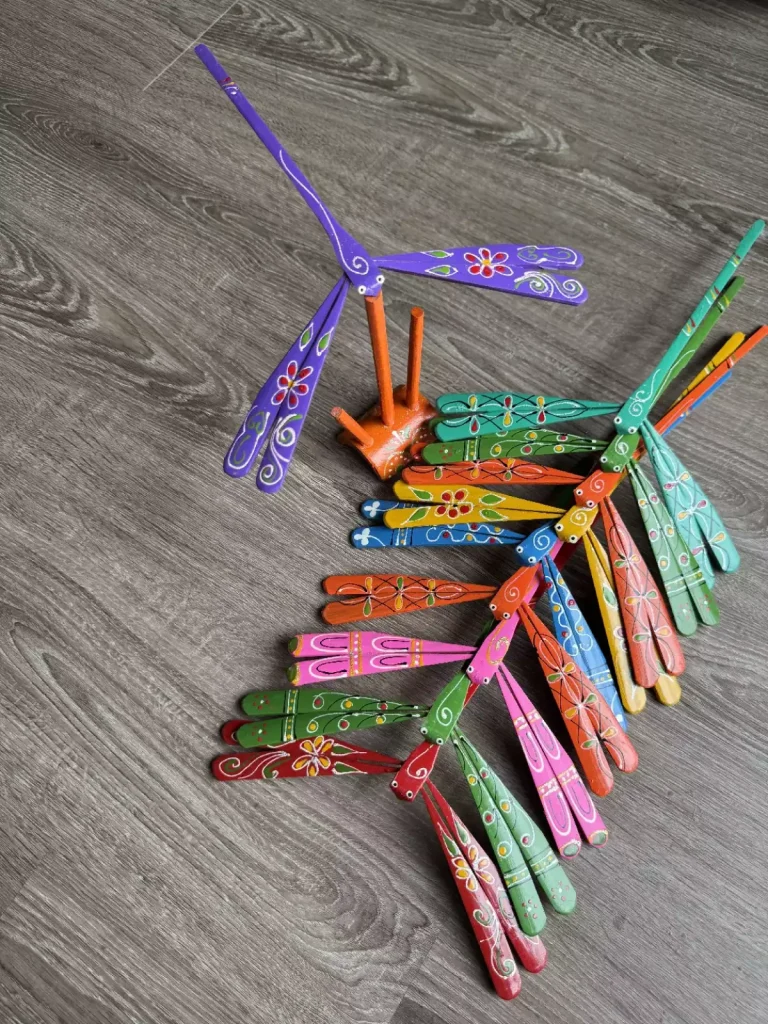
The painted dragonfly is the one most people know. It is the version sold at the base of Tây Phương Pagoda, the one tourists photograph and carry home — a small cloud of reds, yellows, blues, and greens, each wing threaded with a fine painted spiral or a row of tiny flowers. Xoan mixes her colours by eye. The red is never quite the same red twice; the blue leans toward indigo in one batch, toward cobalt in the next. No two painted pieces are identical.
Most painted dragonflies carry a traditional folk pattern on the wings: a small five-petal flower, a spiral band, a dotted trail along the wing edge. Some carry a national flag — Vietnamese red-and-yellow, American stars-and-stripes, the French tricolour — painted to order when a customer asks. Others carry a name, a date, or a short phrase, which the atelier calls the personalised version.
A painted piece takes roughly twenty minutes of structural work and anywhere from five to forty minutes of painting, depending on the pattern. A simple three-colour dragonfly is done quickly. An elaborate one can keep Xoan at the bench for most of an hour.
The natural dragonfly
The natural dragonfly is the quieter cousin. It leaves the bench unpainted, sanded smooth, and shows the bamboo grain as it is — pale straw-yellow fading toward cream along the body, with the fine horizontal lines of the culm running the length of the wings. It is the dragonfly at its most architectural.
Without paint, every cut becomes more visible. A crooked wing or a rough taper has nowhere to hide. The natural finish therefore tends to be reserved for the cleanest pieces — the ones Liên is most pleased with structurally. In a sense, a natural dragonfly is a maker’s statement: this one did not need dressing up.
Which one is more traditional?
Both are. The painted version grew out of the village’s tourist trade in the early 2000s; the folk motifs on the wings echo the colour vocabulary of Vietnamese lacquerware, pagoda carvings, and New Year prints. The natural version is closer to the bamboo toys that were carved in northern villages long before anyone thought to sell them — whistles, stilts, spinning tops — where the material was always left to show. Neither finish is older than the other. They grew up together.
Which one fits the room?
This is where the honest difference lives.
A painted dragonfly brings colour and story into a room. It reads as folk art. It sits well against a white wall, a pale bookshelf, a child’s bedside table. In a minimalist interior, it provides the single bright accent that keeps the space from feeling clinical. In a room that already has pattern — a Berber rug, a painted tile wall — the dragonfly joins the conversation.
A natural dragonfly sinks into its surroundings. In a Scandinavian-leaning interior — oak, linen, concrete — it feels at home. On a desk beside a fountain pen and a leather notebook, it looks more like a quiet object than a toy. In a Japanese-influenced room, paired with a tokonoma ikebana or a ceramic tea cup, it belongs immediately.
A simple test: if the room has colour, choose natural. If the room is quiet, choose painted. The dragonfly will find the contrast.
Which one is more durable?
Both are bamboo, so both will last decades with ordinary care. The painted version picks up small colour wear on the wing edges over years of handling — which many customers consider part of the character — and can be touched up with a fine brush if needed. The natural version can darken slightly over the years, the way raw wood does; some collectors prize this patina, and others rub the piece with a trace of natural oil to slow it. Neither needs more than a soft cloth.
Which one makes a better gift?
For a child, a teacher, a first Vietnamese gift, or anyone who will meet the dragonfly without context — the painted version, almost always. It smiles. It is immediately itself.
For a collector, a designer, an architect, a minimalist, or someone you have already given a painted one to — the natural version. It is the quieter gift, and the one people tend to keep on the desk rather than the shelf.
The in-between option
There is a third finish the atelier makes quietly: a lightly-painted dragonfly with only the eyes, the beak, and a thin band of colour along the wing edge. The bamboo grain shows through most of the piece; the colour is a suggestion, not a pattern. It is the finish most customers reach for when they cannot decide between the first two.
The short answer
Painted is the heart. Natural is the bones. They are the same dragonfly, tuned by the same hands, and which one belongs in your room depends on what else is already there. Browse the bamboo collection for both finishes, or see everything the workshop makes in the full shop.
If you want to take it a step further, the atelier also offers personalised pieces with a name or date on the wing. Once you have one, our short guide to five ways to display it at home may help it find its spot.
