
Journal
Handmade gifts from Vietnam under $30
Apr
Vietnam makes a good gift. Not because it is inexpensive — though it often is — but because a very old habit of making things by hand has never quite gone away. Walk through any northern craft village and you find the same pattern: a material, a family, a bench, three generations. The gift that comes out of that bench has a specific quality that mass-produced objects do not have. It is not perfect. It is particular. And for under thirty dollars, a surprising amount of it is still available to travellers, long-distance friends, and anyone wanting to send something across an ocean with a story attached.
Why a handmade gift travels differently
A mass-produced object arrives and joins a pile of similar objects. A handmade one is followed by a question — who made this? — and the answer tends to stay with the recipient longer than the gift itself. A bamboo dragonfly balanced on a bookshelf is eventually pointed at by a visitor; a silk scarf folded in a drawer is pulled out to explain the stitching. The object becomes a small standing invitation to tell the story of the place it came from. That is the specific thing handmade gifts do well.
Under thirty dollars is also, by chance, the sweet spot for this kind of gift. Below fifteen dollars, objects start to feel more like souvenirs than crafts. Above fifty, the weight of value overtakes the warmth of the gesture. Thirty is the band in which the object stays small and personal and still shows its maker.
A short tour of Vietnamese craft
Northern Vietnam concentrates its crafts in villages. Each village has, historically, made one thing, and the neighbours next door have made another. West of Hanoi, the cluster known as Xứ Đoài runs the full range: Bình Phú weaves bamboo and rattan into baskets and trays; Chàng Sơn carves wood; Phú Vinh, further south in Chương Mỹ, has been the country’s rattan capital for four centuries. South of the city, Bát Tràng throws the pottery that every Vietnamese household has a piece of somewhere. North of the Red River, Vạn Phúc still weaves silk on hand looms older than the weavers operating them.
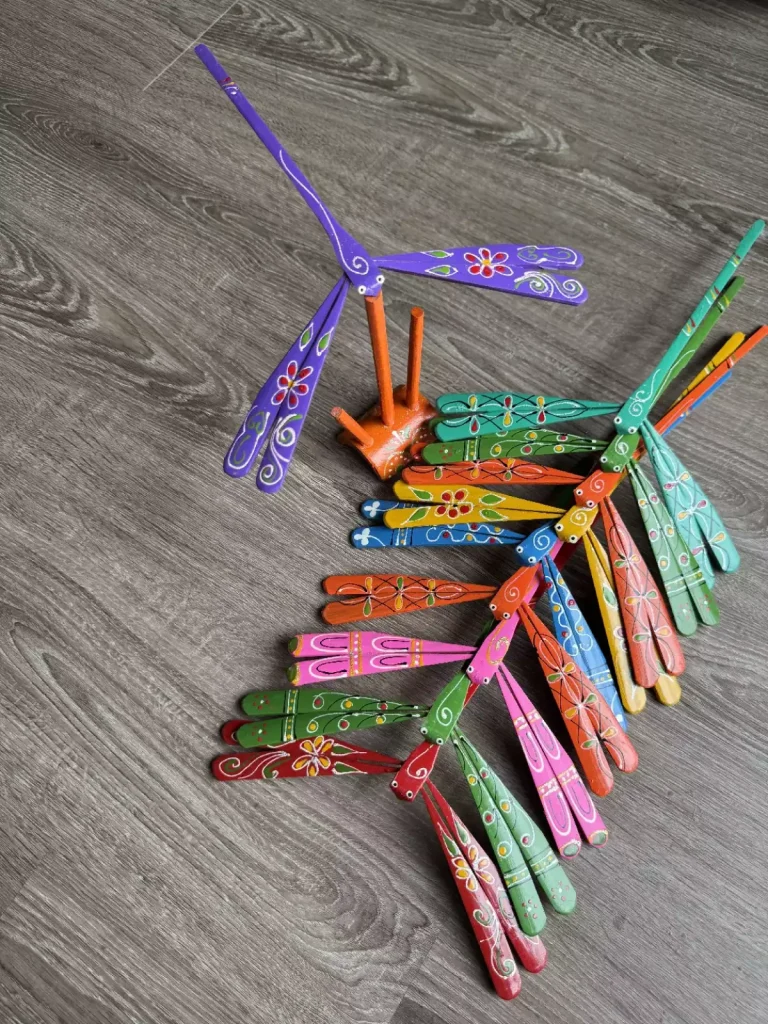
Most of what these villages make sits comfortably inside a thirty-dollar budget. A woven rattan tray from Phú Vinh — twelve to twenty dollars. A small Bát Tràng ceramic bowl — eight to fifteen. A Vạn Phúc silk scarf — twenty-five to forty for the light, everyday weights. A pair of hand-embroidered handkerchiefs from Quất Động village, closer to Hanoi — around ten. And a balancing bamboo dragonfly from Thạch Xá — between ten and twenty, depending on the paint work.
Why the bamboo dragonfly travels well
Among the under-thirty crafts, the bamboo dragonfly sits in a small category of its own: it is the Vietnamese handicraft that arrives already doing something. It balances. A scarf waits to be worn, a bowl waits to be filled, a tray waits to be used — but a dragonfly comes out of the bubble wrap, perches on a fingertip, and makes the recipient smile on the spot. The story does not have to wait for a moment.
It is also small and light. A single dragonfly packs flat in a small box and ships internationally for a few dollars. Nothing inside is fragile in the usual sense — no ceramic to chip, no glass to break. The paint cures for a week at the atelier before the piece travels, so it arrives the colour it was posted.
The occasions it fits
A bamboo dragonfly is the rare gift whose meaning bends to suit the person. For a child’s birthday, it is a toy that teaches patience — finding the balance is half the game. For a housewarming, it is a small piece of Vietnamese summer for a windowsill or a desk. For a retirement, it reads as a life well-balanced, the weight distributed just so. For a physics teacher, it is the single best desk demonstration of centre-of-mass ever carved from a sliver of bamboo. For a grandchild who has never seen a rice paddy, it becomes a way to pass on a grandparent’s proverb without sitting anyone down.
And for the recipient who has, quietly, lost someone, the Japanese folk reading — that the dragonfly carries the soul of an ancestor back for a visit — has travelled into Vietnamese homes too. It is rarely spoken of out loud, and it does not need to be. The dragonfly on the shelf is enough.
How to choose a handmade gift from Vietnam
Three small questions help:
1. Will it survive the journey? Lightweight, unbreakable, and small enough for a padded envelope is the safest bet. A dragonfly, a silk scarf, an embroidered handkerchief, a lacquerware chopstick rest — all travel well. Ceramics need more care.
2. Does the maker have a name? The difference between a gift with a maker’s name and one without is considerable. The first is personal; the second is merchandise. Many Vietnamese craft villages — including Thạch Xá — still work at the level of the family workshop, where the hands that made the piece can be identified.
3. Will the recipient understand it? A bamboo dragonfly explains itself in about four seconds — set it on a fingertip and it balances. A silk scarf or a Bát Tràng bowl has more context to carry. For recipients who have never been to Vietnam, the gifts that do their own talking work best.
A small list, under thirty
- Balancing bamboo dragonfly — $10–20, depending on paintwork. The single piece of Vietnam that arrives already performing.
- Vạn Phúc silk scarf (light weight) — $25–40. Hand-loomed; look for the small red-and-white selvedge that marks the traditional village pieces.
- Bát Tràng ceramic rice bowl — $8–15. Breakable, so not ideal for posting; perfect if handed over in person.
- Phú Vinh rattan tray — $12–25. Light, flat, and deeply useful. Survives a suitcase easily.
- Buffalo horn keychain — $8–15. Carved from a by-product of the food industry, no animal killed for the material. The atelier also carries buffalo horn pieces carved in the same village.
- Quất Động embroidered handkerchief — $8–12. A flower, a crane, a phrase — stitched by hand in a village known for fine embroidery.
- Hand-pulled rice paper notebook — $15–25. Uncoated, textural, ideal for a letter-writer.
A personalised version
For the recipient who will get it once and remember it, the atelier paints a name or a date onto the wing of a single dragonfly — twenty-plus dollars, shipped direct from the village. For weddings, birthdays, new homes, and the occasional retirement, it is the version that tends to stay on the shelf the longest. See our full guide to personalised bamboo dragonflies, or read about painted versus natural finishes and how we ship overseas.
The short version
Under thirty dollars, the best handmade gifts from Vietnam have one quality in common: they come from a village, and the village still makes them. That alone is rarer than it sounds. If you are choosing one, and you want the object that does the most with the least — the one that travels lightest, explains itself fastest, and keeps the recipient coming back to it — the dragonfly is hard to beat. Browse the shop, or start with the bamboo collection.
If you are shopping with sustainability in mind, we wrote separately about eco-friendly gifts that people actually keep rather than quietly put away.
