
Journal
Bamboo in Vietnamese Culture: A Thousand Uses
Apr
A freshly cut culm leans against a whitewashed wall, drying in a rectangle of sun. Further down the lane, a woman sets a flat bamboo tray of rice cakes out on a stool, then props open her doorway with a woven basket that has been in the family longer than she has. A child runs past carrying a stick longer than he is tall. In Vietnam, you cannot walk a day without seeing it.
A material, not a decoration
Bamboo is the material of northern Vietnam in the same way oak is the material of England or cedar the material of Japan. It grows fast, it splits straight, and it is light enough to balance. Generations of village craftsmen have worked it into everything from baskets and furniture to the small objects of a childhood. To understand bamboo in Vietnamese culture is to understand how an entire civilisation organised itself around one plant: its houses, its kitchen, its toys, its poems, and eventually its exports.
What bamboo actually is
Bamboo is not a tree. It is a grass — the largest member of the family Poaceae — which is why it grows the way it does: upward in a single season, hollow between the nodes, with fibres that run almost perfectly parallel to the stem. Vietnam is one of the richer bamboo countries in the world, with more than two hundred species documented across its forests and villages, from the thick-walled luồng of Thanh Hóa to the slender trúc favoured by artisans. Some species can gain half a metre in a day. The strength-to-weight ratio of a well-seasoned culm rivals softwood, and for slender work — a fan rib, a kite spine, the wing of a balancing insect — nothing else behaves quite the same way.
Bamboo in the Vietnamese house
Walk into any old rural house in the Red River Delta and the building itself will be telling you something. Roof beams of bamboo, lashed rather than nailed. Walls of bamboo lattice packed with mud and rice straw. Floors of split, flattened culm — springy underfoot, cool in August. Gutters and short water pipes formed by knocking out the internal membranes of a single length. Fences of woven nan, tall enough to keep a buffalo on its own side. Ladders. Shoulder poles. The slatted bed a grandfather still naps on after lunch.
Older villagers will tell you that a well-built bamboo house lasts thirty or forty years, and that when it is finally taken down, almost every part of it can go somewhere else — into a fence, a chicken coop, a cooking fire. It was, long before the word existed in marketing, a circular material.
Bamboo in the Vietnamese kitchen
The plant also feeds the household. Fresh and fermented bamboo shoots — măng tươi, măng chua, măng khô — anchor dozens of northern dishes, from the duck-and-shoot soup of a winter funeral to the everyday braise a mother makes on a Tuesday. In the uplands, sticky rice is cooked inside a green bamboo tube over a charcoal fire and eaten straight from the split cylinder; the dish is called cơm lam, and it tastes faintly of the grass it was cooked in.
Around that food sits a whole category of bamboo tools so ordinary no one notices them: chopsticks, rice paddles, steamer baskets stacked three high over a clay pot, flat winnowing trays, fine strainers for pulling noodles out of broth, cages for carrying a live chicken to market. None of these objects is precious. All of them are quietly, specifically good at what they do.
Bamboo as memory — toys and childhood
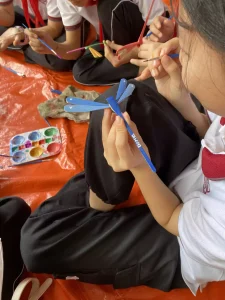
Ask a Vietnamese adult what their first toy was and the answer is very often bamboo. A whistle cut from a thin culm, two notches and a bevel. A pop-gun — súng phốc — that fires a damp paper pellet with a satisfying thud. A water gun carved from a single length with a piston of rag-wrapped stick. A spinning top. A stilt. A see-saw — cầu bập bênh — balanced across a log in the yard.
And then there is the balancing dragonfly. It should not be confused with the Japanese taketombo, the bamboo-copter that spins off the palms — that is a different toy with a different physics. The Vietnamese chuồn chuồn tre does not fly; it balances. One point on the tip of its beak, wings spread, tail arched, the whole insect held in mid-air on a finger or a bottle-rim by nothing more than the geometry of its own weight. Children learn its trick early: shift the wings, shift the balance. It is the first small lesson a Vietnamese child gets in the idea that matter can be made to behave if you understand its centre.
The craft villages — Xứ Đoài and beyond
Vietnamese crafts have almost never been the work of a single workshop. They cluster. West of Hanoi, in the old cultural region called Xứ Đoài, a handful of neighbouring villages have specialised for generations, each in a different aspect of the same broad material family. Bình Phú weaves — fans, trays, fine bamboo matting. Chàng Sơn carves and carpenters, turning heavier timber and thick bamboo into furniture, altars, and the wooden components of traditional houses. Thạch Xá, a few kilometres away at the foot of Tây Phương pagoda, makes the balancing dragonflies. Further south in Chương Mỹ district, Phú Vinh has been the country’s rattan capital for roughly four centuries.
The cluster model is not an accident. Skills, tools, suppliers and buyers all concentrate. A split-bamboo offcut from the carpenter’s yard in Chàng Sơn can become a dragonfly wing in Thạch Xá the following week. It is a quiet, functional ecology of craft.
Bamboo in proverb and poetry
No other plant has sat so deeply inside Vietnamese literature. In 1955, the writer Thép Mới composed his well-known prose piece Cây tre Việt Nam — “The Vietnamese Bamboo” — as commentary for a Romanian documentary of the same name. Its opening line, memorised by generations of schoolchildren, simply declares: “Cây tre là người bạn thân của nông dân Việt Nam, của nhân dân Việt Nam” — the bamboo is a close friend of the Vietnamese farmer, of the Vietnamese people.
A generation later, the poet Nguyễn Duy wrote Tre Việt Nam (1971–72), the lines of which are still quoted at weddings and commemorations: “Tre xanh, xanh tự bao giờ? / Chuyện ngày xưa… đã có bờ tre xanh.” Green bamboo — how long has it been green? The old stories already had a green bamboo hedge. When Vietnamese people want to talk about endurance, uprightness, or the quiet dignity of village life, they reach, almost without thinking, for bamboo. The dragonfly made from it carries its own quieter weight — see our piece on Vietnamese folklore of the dragonfly and the pagoda where the craft began.
Bamboo in the modern Vietnamese economy
The plant still earns its keep. Bamboo and rattan handicrafts are among Vietnam’s steady export categories, with finished goods going to Europe, Japan and North America. Under the national OCOP programme — One Commune, One Product, launched in 2018 — dozens of bamboo crafts from villages like Phú Vinh and Thạch Xá have been certified at three- and four-star levels, a quiet form of geographic recognition. And in the forestry accounts, bamboo is increasingly being counted for what it does beyond objects: it sequesters carbon fast, stabilises riverbanks, regrows without replanting, and asks almost nothing of the soil.
Why bamboo still matters
It is tempting, from outside Vietnam, to treat all of this as nostalgia — the charming material of a pre-industrial village. It isn’t. The reasons bamboo worked for a thousand years are the same reasons it works now: it is local, it is renewable, it can be shaped by hand, and it fails gently. A broken bamboo basket goes on the fire. A broken plastic one goes on the planet. Choosing a bamboo object, in 2026, is not a folkloric gesture. It is a quietly modern one — an argument, in the hand, for slow materials made by people you can, in principle, meet.
The Thạch Xá dragonfly as a bamboo object
Which brings us, finally, back to the insect on the shelf. The balancing bamboo dragonfly could only have come from a material tradition like this one. The body, the head, the long arched tail, the two thin wings — every part of it is cut from a single culm of Vietnamese bamboo, shaved down by hand in the workshops of Liên Xoan and her neighbours. No plastic. No metal. No glue that wasn’t mixed that morning. Entirely bamboo, entirely manual, entirely handmade.
If that feels like a small thing to celebrate, consider what it actually is: a grass that grew in a northern village, cut by a farmer, split by a craftsman, painted by his wife, and balanced — perfectly — on the tip of its own beak. A thousand years of material knowledge, resting on a finger. Browse the bamboo collection, or see the full Bamboo Dragonfly shop.
