
Journal
Visiting the bamboo dragonfly workshop near Hanoi
Apr
The road west out of Hanoi runs straight for about thirty kilometres, past paddy fields and the low ridge of the Ba Vì mountains, until the land flattens and the turn-off for Tây Phương appears on the right. Forty kilometres from the Old Quarter, ninety minutes by car, Thạch Xá is near enough for a day trip and far enough for the city to feel like it has been left behind. At the end of the lane is the atelier. Visitors who come to make their own bamboo dragonfly come here.
What the visit is
The Liên Xoan workshop visit is a hands-on session at the atelier, held on weekdays by appointment, lasting roughly two to three hours. Guests shape, assemble, paint, and tune their own dragonfly, and take it home at the end. The group is kept small — up to six people — because the bench is a working one, and anyone more than that would stop being a workshop and start being a tour.
Liên leads the bamboo work. Xoan leads the painting. Both speak Vietnamese comfortably and everyday English; their son handles translation for French, German, Korean, and Japanese guests when needed. The atmosphere is the atmosphere of an ordinary working morning — radio in the background, a kettle in the corner, neighbours passing the door.
A typical session, minute by minute
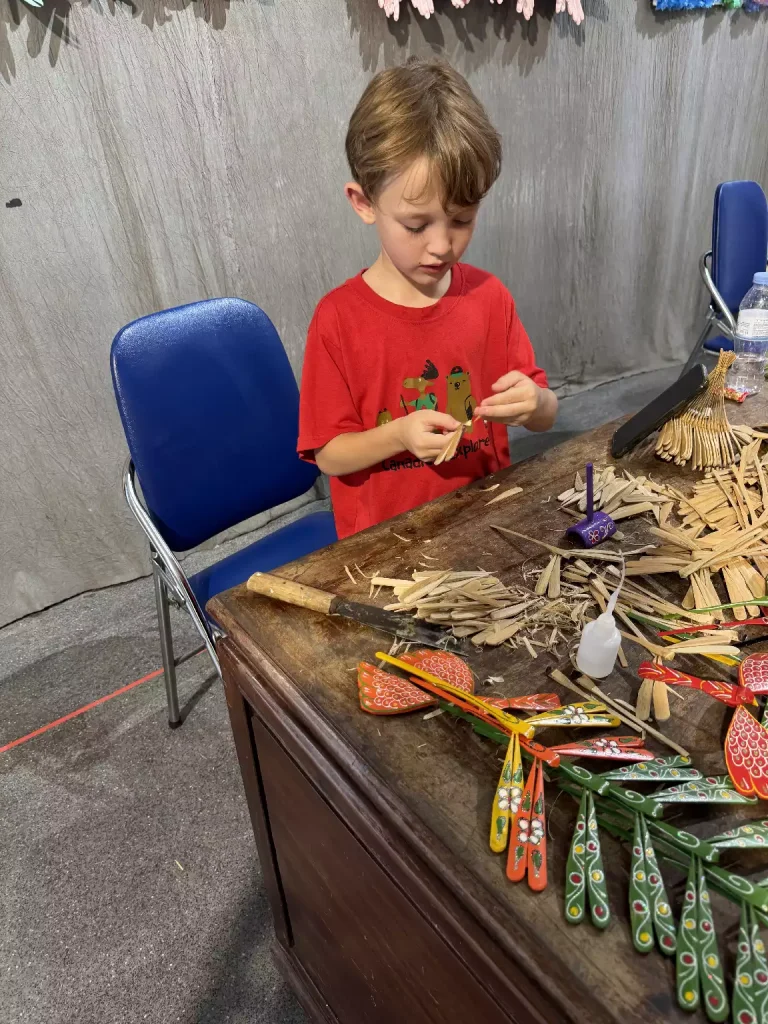
The first thirty minutes are Liên at the bench with a handful of bamboo splits, showing how a strip becomes a body and how a thinner strip becomes a wing. Guests try the splitting themselves on pre-cut culms — supervised, because a fresh blade and unfamiliar bamboo can part company quickly — and then move to shaping the pieces with small knives and sandpaper.
The next forty minutes are assembly and tuning. The wings are fitted, the tail seated, and the balance tested on the tip of a chopstick. This is the part most guests describe afterward as the hardest and the most satisfying — shaving a sliver off one wing, re-testing, and watching the dragonfly finally settle still.
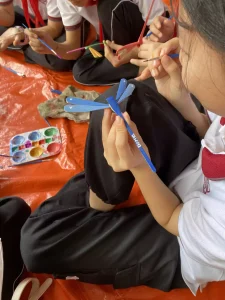
The final hour, roughly, is Xoan’s. She lays out her paints — small cups of indigo, vermilion, turmeric yellow, leaf green — and hands each guest a brush. The first coat is a ground colour across the wings. The second is pattern: a fine spiral, a row of small flowers, or, if the guest prefers, their own improvisation. Xoan demonstrates the traditional folk motifs on her own piece and leaves everyone else to interpret.
A light lunch is served at the end, prepared by the family — usually rice, a stewed vegetable, and a small soup, the kind of home cooking most restaurants around Hanoi do not serve. Guests leave with the dragonfly they made, wrapped in tissue for the journey home.
Who the workshop suits
Families with children over eight. The bamboo work requires small, focused hands; under eight and the knife becomes more hazardous than educational. Children between eight and twelve enjoy the painting most. Teenagers tend to prefer the tuning.
Couples looking for a half-day away from Hanoi. The workshop fits neatly into the morning, with Tây Phương Pagoda above the village for the afternoon. A good two-stop day, ending back in the Old Quarter by early evening.
Small corporate groups and school trips. The atelier has hosted teacher-training cohorts, design-school classes, and a handful of team-building days. Groups over six are run in two staggered sessions rather than a single overcrowded one.
Anyone who has bought a dragonfly and wants to see where it came from. This is the category the atelier enjoys most — guests who have already owned a piece for months or years and now want to meet the hands that made it. The workshop tends to move quickly for this group, because the respect is already established.
What to bring
Comfortable clothes that can pick up a spot of paint without drama. Closed shoes, because bamboo shavings on the floor are softer than they look but still something to notice. A phone or small camera for the bench, which has been the site of several thousand quiet portraits over the years. And an hour of spare patience — the tuning step is slower than anyone expects, and faster once you stop rushing.
No need to bring tools or materials; everything is provided. Water and tea are always on the counter.
Getting there from Hanoi
By car or ride-hail, the journey takes about an hour in fair traffic, closer to ninety minutes on a Friday afternoon. Coming from the Old Quarter, the driver takes Đại lộ Thăng Long westbound to the Tây Phương turn-off; the atelier is a short drive through the village from there. Public buses run from the city’s western bus terminals to Tây Phương, though the final half-kilometre from the main road to the atelier is easier by motorbike taxi than on foot.
For first-time visitors to Thạch Xá, the atelier is happy to send a pinned map and a local driver recommendation when booking; the village lanes are narrow and signage is limited.
Combining the workshop with Tây Phương Pagoda
Most visitors pair the workshop with a climb to Tây Phương Pagoda, a fifteenth-century wooden temple on the hill directly above the village. The pagoda is a national special heritage site; its eighteen Arhat statues are Vietnamese national treasures, and the climb takes around twenty minutes from the staircase at the base. A morning at the atelier and an afternoon at the pagoda is a well-shaped day.
Alternatively, arrive at the pagoda in the morning, climb before the sun gets high, and come down to the atelier for lunch and the workshop in the early afternoon. Either order works; the village accommodates both.
Booking, cost, and practicalities
Workshops run by appointment on weekdays; weekends are the atelier’s production days and are kept free. To book, use the workshops page or write to the atelier directly; confirmation usually comes back within a day. The session is inexpensive by Hanoi craft-workshop standards — the rate is set to keep the visit accessible to families and students rather than to price it as a tourist experience.
One note: the atelier is a working household, and the family will politely turn away surprise visitors during busy export weeks. The single most useful thing a guest can do is write ahead.
Why guests come back
Most do not. A workshop is, by design, a one-time visit; the dragonfly is made, the story is told, the guest goes home and writes about it for a few weeks afterward. But the atelier has a small tradition of returning guests — families coming back with younger siblings, travel writers returning with photographers, friends sending friends. The bench is often occupied by someone who was there five years ago and has now brought their child to make their own.
That is, perhaps, the real measure of the visit. Not that it was good at the time. That it kept being good afterward.
Come make one
If you are in Hanoi for more than three days, a morning in Thạch Xá belongs on the list. Book a workshop, meet the atelier, and leave with a dragonfly you balanced yourself. More on the atelier itself, the pagoda above the village, and the twenty-minute process you’ll try for yourself.
