
Journal
Inside the atelier: Đỗ Văn Liên and Nguyễn Thị Xoan
Apr
Walk down the narrow lane into Thạch Xá on a weekday morning and you will hear the atelier before you see it. A radio murmuring somewhere behind a curtain; the soft, dry sound of bamboo splits being sorted on a low table; and, if the air is still, the faint scent of bamboo warmed against a hot iron rod.
This is the workshop of Đỗ Văn Liên and Nguyễn Thị Xoan — known in the village simply as Liên Xoan, the oldest dedicated bamboo dragonfly atelier in Thạch Xá, forty kilometres west of Hanoi. The bench is low. The light comes from the doorway. There is no signage on the wall and no machinery in the room. A basket of pale bamboo shavings sits beside the door. Another, half-full of finished pieces, waits to be packed.
A pagoda, a question, a piece of bamboo
Most craft villages pass a trade from one generation to the next. Thạch Xá’s dragonfly trade passes from the other direction: an outsider’s curiosity, a tourist’s souvenir, a piece of bamboo in the hand of a young woman selling at the base of Tây Phương Pagoda.
“Traditional crafts pass from father to son,” Xoan once told a reporter. “Bamboo dragonflies in Thạch Xá are a handicraft I taught myself, while selling goods at Tây Phương Pagoda.” It was around the year 2000. She had seen a small bamboo figure somewhere — how it held itself on a string, how it rocked when you tapped it — and she wanted to make one of her own. Her first attempt was nothing. The second and third, only a little better. The dragonfly that balanced on a fingertip, the way the balancing bamboo dragonfly is meant to, took months of quiet trial and error.
When she got it right, her husband joined her. Liên had worked with bamboo before; he knew how to read a culm, how to split it clean, how to pick the ones that would hold a shape. Together, they began making the pieces for the tourists climbing up to the pagoda. Other households in the village noticed. A second workshop opened, and a third. Twenty-plus years later, roughly ten households in Thạch Xá still make bamboo dragonflies by hand. Liên Xoan is one of the originals — and Nguyễn Văn Tài, another first-generation maker whose workshop lies a few lanes away, is a neighbour and a friend.
Twenty steps, one piece of bamboo
From raw culm to finished dragonfly, a single piece travels through about twenty steps. None of them are mechanised.
It begins with the right bamboo. Liên does not use the hardest kind, nor the softest. He uses tre bánh tẻ — a middle-aged bamboo, neither young nor old — because its fibres are tight enough to hold a shape but still pliable enough to bend under heat. The culm is trimmed, the green skin stripped, and the piece laid out to dry. A few days later, it is split, by hand, into strips about a centimetre wide. The strips are sorted by thickness; Liên can tell by weight alone which split will become a body and which will become a wing.
From there: the wings are cut and smoothed. The body is tapered. The tail is shaped. The body is drilled to receive the wings at the shoulder. Each element is tested for straightness. The beak is bent. The wings are pinned. The painter takes over. The colour is laid in two passes and allowed to dry for close to a week before the piece is ready to travel.
The hardest bend is the beak
Liên heats a slender iron rod over a small burner until the tip shimmers. He lays a cut bamboo body across it, presses for a beat — just long enough — and lifts away. The heat softens the bamboo fibres; the brief pressure gives the head its small upward hook, and the hook, finely shaped, becomes the mouth and the pivot surface on which the whole dragonfly will eventually rest. Done too briefly and the bend springs back; done too long and the bamboo scorches. He learned where the line sits by passing through it, with the first hundred dragonflies, in both directions.
Two hands, one dragonfly
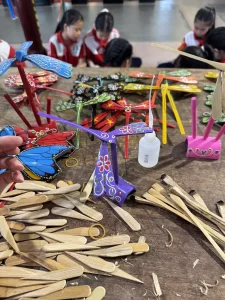
The bench is divided without anyone having to agree it. Liên takes the structural side: bamboo selection, cutting, bending, the fitting of the wings, the final tuning of the balance. Xoan takes colour. She mixes her paints by eye, favours warm fields with needle-tip detailing of flowers and small spirals, and keeps a row of fine brushes in a tin by her elbow. The painted dragonflies we send out of the atelier are almost always her hand.
Twenty years at the same bench teaches a hand a rhythm. Xoan can tell a dragonfly that will balance from one that won’t before the last coat goes on — the body, when she lifts it, feels different in her palm. Liên is the one who tests it. He holds the piece on the tip of a chopstick, watches it settle, feels for where it tips, and returns it for a shaving off one wing if it needs one.
What “finished” feels like
Ask Liên what is the hardest part of making one and he will not say the painting. “The hardest part,” he says, “is attaching the wings so the force is balanced on both sides — so the dragonfly can stand on anything.” A piece is not finished when it looks right. It is finished when it rests, still, on the tip of its own beak. A dragonfly that does not balance, in his view, is not a dragonfly.
From a village lane to five continents
A busy week at the atelier turns out several hundred dragonflies. The bulk of them travel abroad. Resellers in Japan and South Korea take the steady volume. Independent shops in the United States, Germany, France, and the United Kingdom take the seasonal orders. Once every few months a single order will run into the thousands — a wholesale customer ordering for a school, a museum, or a charity drive, sometimes with the Vietnamese flag, sometimes with the American one, painted across the wings to order.
A son of the family now handles the overseas correspondence; most of it arrives in English. For bulk and wholesale enquiries, the workshop replies within a day. A single-piece order — a gift for a grandchild, a name painted on a wing — gets the same attention as a shipment of five hundred. Xoan puts it simply: “I keep the craft because it gave my family the life we have now — it let the children finish school.”
Passing it on
Their children grew up with bamboo shavings on the floor and the smell of hot iron in the kitchen. Some of that generation now works alongside their parents at the bench; others handle the business that has grown up around the craft. On busy weeks, a neighbour or two comes in to help. The room is quieter than it used to be, but the output is steadier.
Liên and Xoan are not trying to make more dragonflies. They are trying to make better ones. A piece that balances longer, a coat of paint that holds its colour, a wing that catches the light in a particular way. Twenty years in, this is still a craft they are learning.
If you would like to see it in person, they still welcome visitors — you can try the craft yourself at the atelier on a weekday, with enough notice. If you would like to take a piece home, the shop has everything the workshop makes, packed one at a time and posted directly from the village.
If you would rather see it happen in front of you, you can visit the atelier and tune a dragonfly yourself alongside the makers.
