
Journal
Twenty-five years at the bamboo dragonfly bench
Apr
Twenty-five years ago, on a spring morning at the base of Tây Phương Pagoda, Nguyễn Thị Xoan finished the first bamboo dragonfly that balanced properly on the tip of a chopstick. It had taken her months of trying. A small tourist picked it up, laughed, bought it for a handful of đồng, and walked off down the road carrying what turned out to be the first of many hundred thousand such objects. This year, 2026, is the quiet quarter-century of that morning. The atelier wanted to mark it gently, the way all good craft milestones should be marked — with a short look back and a longer look forward.
What a quarter-century looks like at a small bench
The arithmetic, if you do it carefully, is surprising. Twenty-five years at roughly three hundred dragonflies a week — a rough average across slow and busy seasons — comes to just under four hundred thousand pieces. Four hundred thousand dragonflies, each balanced on a finger before it left the village. Each one painted, if painted, by the same pair of hands. Each one shipped, now, to an address the atelier knows by postcode.
The bench has not moved. The clock on the shelf is the same clock. Liên’s iron rod is the same rod, with a replacement handle fitted in 2011. Xoan’s paint cups are newer, but only because the ceramic ones she used for the first decade all eventually chipped. Even the radio is the same radio, re-tuned every few years to whichever local station plays the right kind of music for a morning’s work.
The things that changed
The children, to begin with. When the atelier started, the couple’s son was a toddler running around the bench with bamboo shavings in his hair; he now handles the overseas email correspondence and is slowly learning the tuning himself. Their daughter left for university, returned, and runs the accounting. A second generation is at the bench most days, sometimes at it, sometimes in orbit around it.
The map of where dragonflies go has also changed. In 2002 almost every piece was sold at the bottom of the pagoda staircase to a tourist. In 2012 a growing share left the country via resellers in Japan and Korea. By 2022, direct-to-customer shipments had overtaken every other channel; pieces now travel to private addresses in forty-odd countries each year. The workshop is smaller than it was in 2010 — the peak production year — and the output is steadier.
The village has changed too. In 2002, three or four households made dragonflies. By 2010, sixteen did. Today, the number has settled at roughly ten steady workshops, of which Liên Xoan is the oldest. The neighbours’ families know each other’s dragonflies at a glance — a subtle signature in the wing curve, a particular way of painting an eye — the way winemakers can tell each other’s bottles without a label.
The things that did not change
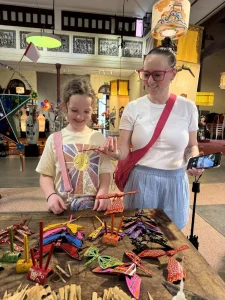
The method, first. Every dragonfly is still made entirely by hand, from bamboo selection to tuning to painting. There is no step of the process, in 2026, that is different from the step in 2002. The only concession to modernity is a small LED workbench lamp, added in 2015, which nobody regrets.
The price, second. Adjusted for inflation, a single dragonfly today costs a little less than it did a decade ago — kept deliberately low so the object remains a gift rather than a luxury. This was Xoan’s decision. Her view is that a dragonfly should be something a child can hold without the parent wincing at the price tag.
The letters
In a drawer beside the bench, the atelier keeps a small archive of letters from customers. It began by accident — someone wrote back to say thank you, and Xoan could not bring herself to throw the note away. Twenty-five years later the drawer is a quiet chronicle of the craft’s reach.
A grandfather in Osaka writes that his granddaughter balances the dragonfly on her fingertip every morning before school. A couple in Berlin report that the piece they ordered for their wedding is still on the mantelpiece twelve years later, now over the crib of their second child. A physics teacher in Ohio sends a class photograph with twenty-four dragonflies on twenty-four students’ desks. A woman in Seoul, whose mother died the week the parcel was ordered, writes only one line: you made the hardest week easier.
These letters are, in the honest reckoning, the reason the atelier has lasted twenty-five years. The bench alone could not have. The hands alone could not have. But an object that arrived, balanced on a fingertip, and stayed on someone’s shelf — and came back, years later, as a thank-you note — was reason enough to cut more bamboo the next morning.
An anniversary piece
To mark the twenty-fifth year, the atelier has released a small run of anniversary dragonflies. They are natural-finish pieces — the grain of the bamboo showing through — with a single fine indigo line along the wing edge and, on the underside of the body, the painted initials LX and the number 25. The batch is limited to two hundred pieces; each is numbered by hand, and each is signed on the tail by Xoan herself.
They are available only through direct order from the village and only while the run lasts. When the batch is gone, the atelier does not plan to repeat it; the whole point of an anniversary piece is that it does not come around again.
What the next twenty-five years look like
Liên and Xoan are in their late fifties now. They are not trying to scale. They are trying to hand the craft, slowly and properly, to the next generation — the son who handles the emails, the daughter who handles the accounts, a nephew who has been painting for two years and is beginning to be good at it. The question of whether the bench will still be at this bench in 2052 depends entirely on whether one of them decides to take it on. Neither parent is pushing. The craft, they say, has to choose its own person.
In the shorter term, the plan is quieter. A small expansion of the workshop visits for school groups. A modest increase in personalised pieces, which have become the atelier’s favourite kind of order. A steady rate of production that does not tire anyone out. And the letters — always the letters.
A small thank-you
To every customer who has written in, every tourist who carried a dragonfly home in a bag of shopping, every teacher who put one on a classroom shelf, every grandparent who handed one to a child and said look, it balances — the atelier is, quietly and sincerely, grateful. The craft would not have survived twenty-five years without an audience willing to let it.
If you would like to take a piece home this spring — anniversary or otherwise — the shop has everything the workshop currently makes. If you would like to visit the bench, the workshop visit guide is the place to begin, and our story page holds the longer arc.
Twenty-five years. Four hundred thousand dragonflies. Two pairs of hands. One small clock on a shelf, still ticking, still quiet.
