
Journal
How Does a Bamboo Dragonfly Balance? The Physics
Apr
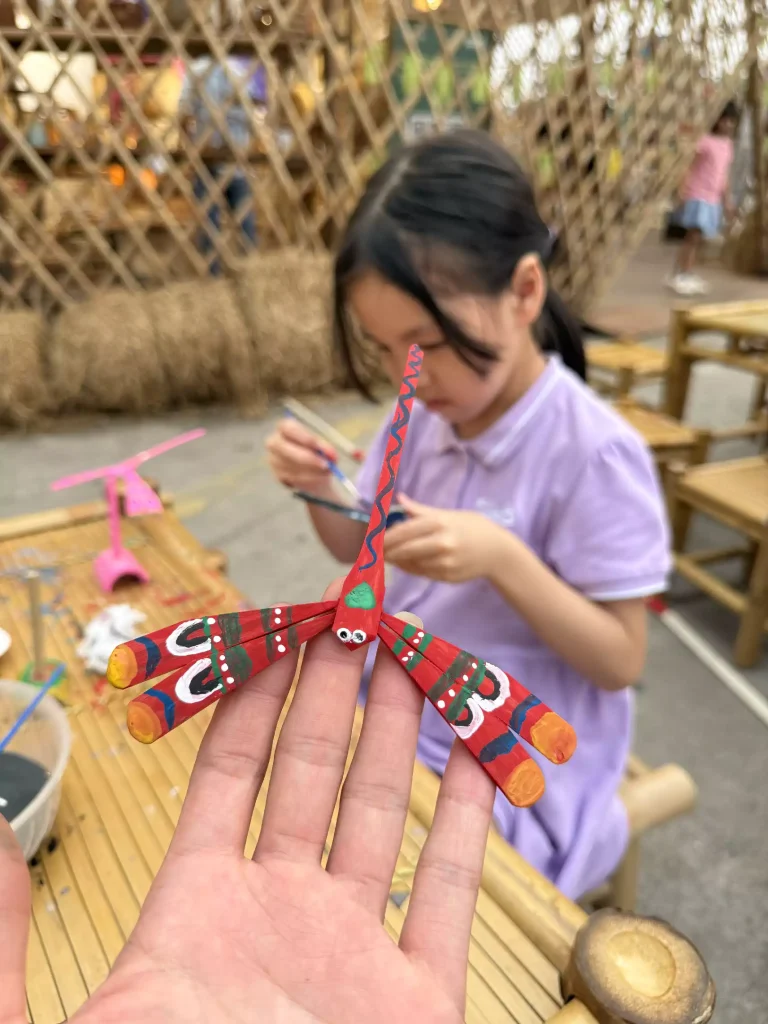
Set the beak on your fingertip. Let go. The wings dip, steady, hold. The whole toy seems to hang from the point it stands on. Tilt your finger a little — it rocks, returns. Blow on a wing — it nods, comes back. A piece of split bamboo, no hinge, no weight inside, balancing on a point the width of a grain of rice.
People usually smile before they ask how. The answer is older than the toy: it is the same reason a tightrope walker carries a long, drooping pole, and the same reason a pendulum always swings back to the bottom. A balancing bamboo dragonfly is tuned, by hand, so that its centre of mass sits below the point it rests on.
The short answer: the weight hangs below the beak
Every object has a centre of mass — a single imaginary point where its weight behaves as if it were concentrated. When an object rests on a pivot, physics only asks one question: where is that point in relation to the pivot?
If the centre of mass sits above the pivot, the object is unstable. A nudge tips it further, and it falls. If the centre of mass sits below the pivot, the object is in stable equilibrium. A nudge tips it, and gravity pulls it back — the same way a pendulum returns to the bottom of its swing.
The bamboo dragonfly is the second case. Its tip is the pivot. Its effective weight hangs invisibly below that tip. That is the whole trick.
What “centre of mass” actually means
Try two small experiments with household objects.
First, stand a pencil on your fingertip, eraser down. You can do it for half a second if you are lucky. The pencil’s centre of mass is roughly in its middle — well above your finger. The smallest lean becomes a bigger lean. Gravity amplifies the error. This is unstable equilibrium.
Now dangle the same pencil from a string tied near the eraser. Push it sideways. It swings and returns. The centre of mass is below the string, and gravity keeps pulling it back toward the lowest point it can reach. This is stable equilibrium — a pendulum.
A balancing bamboo dragonfly is somewhere between the two. It looks like a pencil standing on a point — but it behaves like a pendulum hanging from one. The beak is a pivot with the weight slung beneath it, not above. That is why a small disturbance produces a small wobble, not a fall.
Why the wings sweep forward and curve down
Look at the toy from the side. The wings do not stand out sideways like a cross. They sweep forward, past the beak, and they curve downward, their tips dropping below the beak line. That geometry is doing two jobs at once.
The forward sweep pulls the combined centre of mass of the two wings in front of the body. Added to the tail behind, this brings the whole toy’s centre of mass close to the beak tip — roughly directly under it, which is what a pivot needs.
The downward curve does the more important job. Because the wingtips hang below the beak, the combined centre of mass of the dragonfly sits lower than the pivot point. That is the stable-pendulum condition. The further the wings droop, the lower the centre of mass, and the calmer the dragonfly sits. Tip it — gravity pulls the low wings back underneath. The same geometry is used in the classic “balancing bird” physics demonstration, and engineers rely on it in pendulum-stabilised cranes and some gyroscope-free toys.
Why the tail matters
The wings pull weight forward. Left alone, that would tip the dragonfly off the front of your finger. The tail is the counterweight.
A maker’s job is to tune the tail’s length and thickness so that the weight in front of the beak and the weight behind the beak are exactly balanced — horizontally. Vertically, the drooping wings take care of stability. Horizontally, the tail takes care of aim. Together they place the centre of mass directly below the tip of the beak, which is the only place it is allowed to be.
Why no two dragonflies are tuned the same
Bamboo is not plastic. One culm is denser than the next. One wing blank, split from the same node, can be a fraction heavier than its twin. The grain runs differently; the node spacing changes; a wet season stalk dries lighter than a dry season stalk.
You cannot mould a balancing dragonfly in a press and expect it to balance. You have to meet each piece of bamboo where it is. That is why these toys are entirely bamboo, entirely manual, entirely handmade — not as a slogan, but as a physical necessity. A machine that could weigh, cut and correct every wing individually would essentially be reinventing the human hand.
This is the work of Đỗ Văn Liên and Nguyễn Thị Xoan, who run the Liên Xoan atelier in Thạch Xá village, about forty kilometres west of Hanoi. Every dragonfly they sell has been tuned individually, by eye and by finger, before it leaves the workshop.
The tuning ritual
The tuning happens at the end, after painting, when the piece is nearly finished. Liên uses the tip of a chopstick as a test stand — the same diameter as a fingertip, but steadier and always at the same height.
He sets the beak on the chopstick. He watches. If the dragonfly tips forward, the tail is too light and he sands a sliver off the underside of a wing instead, pulling the centre of mass back. If it tips back, he shaves the tail. If it rolls to one side, one wing is heavier than the other and he takes a few strokes of fine sandpaper off the heavy one’s underside, where no one will see.
Then he retests. Then he sands again. A finished dragonfly has usually been put on the chopstick eight or ten times. The last test is a tap on one wing: it should nod, hold, and settle — not spin off, not fall. When it does that, the tuning is done.
A classroom demo that children remember
Science teachers like this toy because it makes an abstract idea visible in about four seconds. You do not have to explain stable equilibrium; you hand over the dragonfly and let the child poke it.
For a lesson, three questions work well. Where do you think the weight is? (Point to the wingtips.) Why does pushing it down make it come back up? (Because gravity pulls the low part lower, and the low part is already under the pivot.) What would happen if we cut the wingtips off? (It would stop balancing — the centre of mass would rise above the beak, and it would tip.) The toy becomes the apparatus and the textbook at once.
When balance slips: a quick re-tune
A dragonfly that has travelled far sometimes arrives slightly off. Humidity swells one wing; a bump in transit bends a tip. Most cases re-tune in under a minute.
Tips forward? Gently bend the tail down a hair. Tips back? Lift the tail the same amount. Rolls left or right? Bend the lower wing up, or the higher wing down, one millimetre at a time. The bamboo is forgiving — work slowly, test between each adjustment on a chopstick or pencil, and stop the moment it settles. For the full step-by-step, see the re-tuning guide, and for how the piece is tuned in the first place, the twenty-minute process at the atelier.
Take one home
Browse the bamboo collection, or visit the shop to choose one tuned by Liên and Xoan themselves.
Frequently asked questions
How does a bamboo dragonfly balance on its beak?
The wings sweep forward and curve downward so that the combined centre of mass of the whole piece sits below the beak tip. The beak becomes a pivot with the weight slung beneath it, not above it. Tilt the piece and gravity pulls it back upright, exactly the way a pendulum returns to the bottom of its swing.
Why does the dragonfly not fall over like a pencil standing on its tip?
A pencil stood on its tip has its centre of mass above the pivot — that is unstable equilibrium, and any disturbance gets amplified. The bamboo dragonfly is the opposite. Its centre of mass sits below the pivot point, which is stable equilibrium. Small disturbances produce small wobbles that correct themselves, not falls.
Is there a hidden weight or magnet inside the dragonfly?
No. Every dragonfly is a single piece of shaped bamboo with thin bamboo wings. No counterweight, no magnet, no hollow chamber. The balance comes entirely from the wing geometry — the forward sweep and downward curve — that places the centre of mass below the beak.
Can I calculate where the centre of mass is?
In principle, yes — integrate mass over the volume of the piece. In practice, the atelier does it by hand. The maker sets the piece on a fingertip and bends wings in 1-millimetre increments until it settles. A tuned piece rocks without falling; that rocking is the signature of the centre of mass sitting just below the pivot.
Does humidity affect the balance?
Yes. Bamboo is a porous plant fibre that absorbs atmospheric moisture. A dragonfly tuned in a dry workshop may drift slightly out of balance in a humid bedroom, and vice versa. The fix is a 30-second re-tune by bending a wing 1 to 2 millimetres. The underlying physics is unchanged.
If you want to take the idea further with children, the same trick is what turns this into a balancing toy that teaches physics — no screen, no batteries, just centre of gravity you can feel in your hand.
