
Journal
Bamboo Dragonfly Meaning: Vietnamese Folklore & Symbolism
Apr
There is a memory almost every Vietnamese adult shares, even those who left the countryside long ago. A rice paddy in late afternoon, the light turning honey-coloured, and dragonflies — dozens of them — skimming so low their tails graze the water. A grandmother glances up from the doorway, squints at the sky, and says, almost to herself, “It will rain tonight.” She does not look at a phone. She does not check a forecast. She has read the dragonflies, the way her mother read them, and her mother before her. By evening the first drops come, soft on the banana leaves, and nobody in the house is surprised.
The proverb that taught a country to read the sky
Every Vietnamese child learns the line, usually before they understand it:
“Chuồn chuồn bay thấp thì mưa, bay cao thì nắng, bay vừa thì râm.”
When dragonflies fly low, rain is coming. When they fly high, the day will be sunny. When they fly middling, the sky will stay overcast. It is a piece of agricultural wisdom polished by generations, and it turns out to be true. Before a storm, humidity rises and air pressure drops; moisture beads on the dragonfly’s translucent wings, weighing them down, and the small insects they hunt are pushed closer to the ground. So the dragonflies hunt low. On a clear dry day the wings are light, the prey drifts up on thermals, and the dragonflies follow. For centuries, long before barometers reached the Red River Delta, this was the forecast. Rice farmers planted by it. Mothers pulled laundry off the line by it. It was, and still is, trusted more than the weatherman — because it was never wrong.
A creature made of summer
In Vietnam, the dragonfly is summer the way the swallow is spring. Its arrival is the season itself: red skimmers over the pond, blue darners threading the bamboo, the sudden cloud of them after an afternoon shower. Children grew up chasing them with a stick smeared in sticky rice, or a long reed, or nothing at all but bare hands and patience. And every Vietnamese child, at some point, hears the old trick: chuồn chuồn cắn rốn mới biết bơi — if a dragonfly bites your belly button, you will learn to swim. The instructions were always the same. Catch a red chuồn chuồn ớt. Lift your shirt. Let it bite. It stings, a little. Then, supposedly, the river holds no fear for you. Nobody believed it entirely. Everybody tried it anyway. That is the shape of a good piece of folklore — half joke, half rite of passage, wholly tied to a long summer afternoon when nothing else needed doing.
The dragonfly in Vietnamese poetry and song
The dragonfly belongs to Vietnamese poetry almost by default — you cannot write about the countryside without it eventually landing on a page. The poet Nguyễn Ngọc Hưng keeps a short poem titled simply Chuồn chuồn ớt, and Trần Mạnh Hảo wrote Chuồn chuồn cắn rốn, both now archived in the national poetry collections at Thi Viện. Most Vietnamese, though, first meet the insect through song. Composer Lê Minh Sơn’s Chuồn chuồn ớt, made famous by singer Ngọc Khuê in the early 2000s, took the image of the red scarlet skimmer and set it against a village childhood — hot noon, a bare field, a girl who has already left. The song became a standard because every listener recognised the picture: the dragonfly is what you remember when you remember being small. The language itself reaches for the same image. To call something chuồn chuồn đạp nước — “a dragonfly touching water” — is to call it fleeting, glancing, gone before it lands. The insect has slipped into Vietnamese the way certain birds have slipped into English: as a way of naming a feeling, not just a creature. For the broader material tradition behind it, see our piece on bamboo in Vietnamese culture; for the place where the craft became a livelihood, Tây Phương Pagoda, above the village.
A short flight across Asia
The dragonfly carries different weights across Asia. In Japan, it is the tombo, and it is almost a national creature — the old poetic name for the country was Akitsushima, the Dragonfly Isles. Samurai wore dragonfly crests on helmets and sword hilts because the insect never flies backwards; they called it kachimushi, the victory insect, and read it as strength and unbending resolve. In China, the dragonfly leans softer: harmony, prosperity, a small piece of good luck, often painted beside a lotus to signal purity and a quiet, settled life. Against those meanings, the Vietnamese dragonfly stands apart. It is not a warrior’s badge. It is not a feng shui charm. It is weather, childhood, summer itself — a working insect in a working landscape, remembered with affection rather than awe.
Why the Thạch Xá craft matters
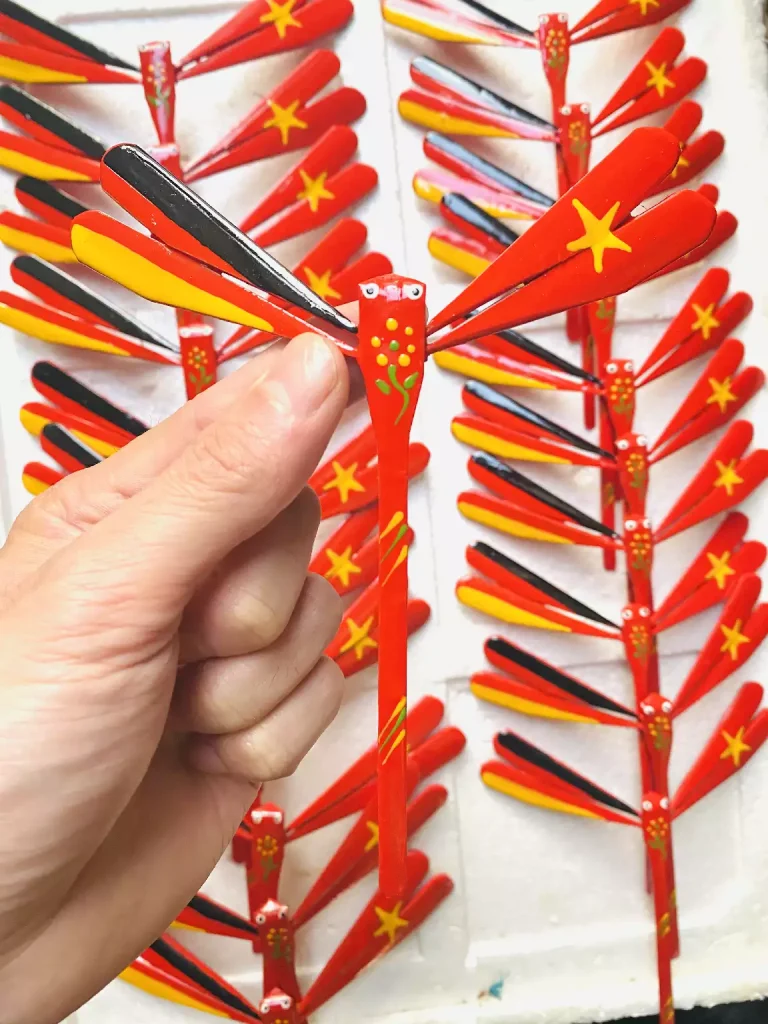
All of that cultural weight — the proverb, the poems, the afternoon by the pond — is what a balancing bamboo dragonfly quietly carries when you set one on a fingertip. The craft comes from Thạch Xá, a village about an hour west of Hanoi at the foot of Tây Phương pagoda. Thạch Xá has been making bamboo dragonflies as a dedicated craft for more than twenty years.
The design is deceptively simple: a body, two wings, a tail, a painted face. The difficulty is in the balance. At the Liên Xoan atelier, the husband-and-wife team Đỗ Văn Liên and Nguyễn Thị Xoan still shave each body by hand, temper the bamboo over a small flame, and test every finished dragonfly on the tip of a finger before it leaves the workshop. A dragonfly that will not balance is returned to the pile. A dragonfly that does is, in a quiet way, the childhood object made tangible again — not a souvenir of the countryside but a working piece of it.
When to give one as a gift
A bamboo dragonfly is the rare object whose meaning bends to the occasion. For a child’s birthday, it is a toy that teaches patience — the balancing point is not obvious, and finding it is the game. For a housewarming, it is a small piece of Vietnamese summer for a shelf or a windowsill, a quiet nod to harmony and good weather ahead. For a retirement, it reads differently again: a life well-balanced, the weight distributed just so. For a grandchild who has never seen a rice paddy, it is a way to pass on a grandparent’s proverb without sitting them down for a lecture. For a physics teacher, it is the single best classroom demonstration of centre of mass ever made from a sliver of bamboo. And for someone who has recently lost someone, the Japanese folk belief — that the dragonfly carries the soul of an ancestor back for a visit — has travelled quietly into Vietnamese homes too. A personalised bamboo dragonfly, painted with a name or a date, lets the giver choose which of those meanings to lean into. The craft stays the same. The story changes.
A small thing, carefully balanced
A dragonfly over a rice paddy. A grandmother reading rain in its wings. A red skimmer a child is still half-afraid of. All of that, distilled into a palm-sized piece of bamboo that stands on a fingertip without falling. Browse the full range in the shop, or add a name to one at personalised bamboo dragonfly. A small thing. Carefully balanced. Quietly Vietnamese.
