
Journal
Tây Phương Pagoda: the temple above the bamboo dragonfly village
Apr
You see Tây Phương before you reach it. The pagoda sits on a low hill — Câu Lâu, an unusual shape for the flat countryside around it — and the three layered roofs of its wooden halls emerge from the trees a kilometre or two down the road. It is one of the oldest surviving wooden temples in Vietnam and, for the craft village at its foot, the reason anyone has ever heard of Thạch Xá. Visit the pagoda, and the dragonflies make sense. Buy a dragonfly, and the pagoda is the small pilgrimage behind every piece.
A temple older than most of Vietnam’s cities
Tây Phương Pagoda — Chùa Tây Phương in Vietnamese — is a Buddhist temple complex on Câu Lâu hill, in Thạch Xá commune, Thạch Thất district, about forty kilometres west of central Hanoi. A temple has stood on this hill since at least the eighth century. The wooden halls that survive today were last fully rebuilt in 1794, during the Tây Sơn dynasty, which is why the architecture reads as late-eighteenth-century rather than older — heavy tiled roofs, finely carved dragons at the eaves, and the unpainted jackfruit wood that Vietnamese temple builders favour.
In 2015 the site was officially designated a National Special Heritage Site, and in 2022 it was named a National Tourist Attraction. The designations matter for preservation funding; for the visitor, they mean the pagoda is one of a small number of northern temples guaranteed a full restoration budget every generation.
The eighteen Arhats
Inside the main hall, seated in two lines along the walls, are the eighteen Arhat statues for which Tây Phương is most famous. Carved in dark jackfruit wood in the late eighteenth century — contemporaneous with the last major rebuilding of the pagoda itself — each Arhat is life-size and unmistakably individual. One sits in meditation with a bird on his shoulder. Another holds a staff with the surprised expression of a man who has just been woken up. Another bares his teeth in laughter.
They were classified as Vietnamese national treasures in 2014. Art historians regard them as the finest surviving set of Arhat sculptures in Vietnam, and one of the most expressive in Southeast Asia. The carvings are the reason a serious art pilgrim will travel out to Thạch Xá even without a dragonfly in mind.
The climb
A stone staircase of 239 steps — older than the modern country around it — winds from the base of the hill to the main gate of the pagoda. The climb takes ten to twenty minutes depending on pace, with two small plateaus along the way where most visitors pause for breath.
The reward at the top is both the temple and the view. On clear days, the rice fields of Thạch Thất fan out below, and the low silhouette of the Ba Vì mountains rises to the northwest. The staircase is enough of a climb that elderly visitors are advised to take it slowly; a handrail runs the full length.
Why the dragonfly craft was born here
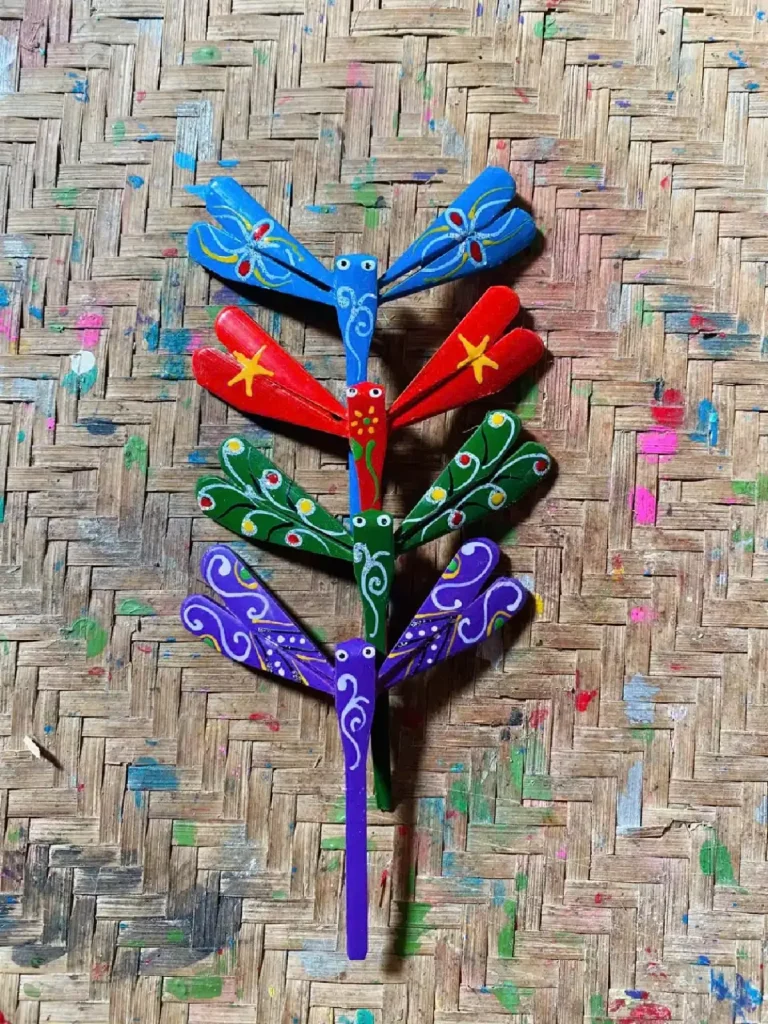
For centuries, visitors have walked up the staircase to Tây Phương. Pilgrims from Hanoi came in the lunar calendar months of Tết and Vu Lan; foreign visitors arrived in smaller numbers starting in the late twentieth century. Around the year 2000, a young woman from Thạch Xá village named Nguyễn Thị Xoan was selling small goods to the visitors at the base of the staircase. Somewhere along the way she saw a bamboo toy that balanced on a point, decided to make one of her own, and spent the next several months working out the geometry by trial.
When she got it right, tourists climbing down from the pagoda noticed the toys and bought them. Word spread. Other households in the village began making dragonflies. Twenty-plus years later, roughly ten workshops in Thạch Xá make bamboo dragonflies by hand — and Xoan’s workshop, Liên Xoan atelier, is the oldest of them. Without the pagoda, there would be no craft.
Visiting the pagoda
Opening hours. The pagoda is open to visitors from roughly 7:00 to 17:00 daily, year-round. Entry is via a modest ticket at the base of the staircase, used to fund maintenance. The busiest days are the fifteenth of each lunar month, and the days of Tết holiday; a weekday visit outside holiday season is peaceful.
Dress. Visitors entering the main hall should cover shoulders and knees, as at most Vietnamese Buddhist temples. Shoes are removed before entering the inner hall. Photography of the Arhat statues is permitted but flash is discouraged.
Best light. Morning light falls on the eastern facade, which is where the main entrance is; the carvings above the main door are at their best between 8:00 and 10:00. Late afternoon brings soft golden light to the top terrace and is the favourite time for photographers.
Pairing the pagoda with the atelier
The pagoda and the atelier are within five minutes’ walk of each other. The most common itinerary is: pagoda in the morning — before the sun gets high and while the stone steps are still cool — lunch in the village, and the atelier workshop in the afternoon. An alternative is to book the atelier for the morning and climb to the pagoda afterward, which works if the weather is mild.
Either order, expect to spend a full day in the village; the round trip from central Hanoi runs to roughly ten hours door-to-door.
Getting there from Hanoi
By car or ride-hail, the drive takes roughly an hour in light traffic, closer to ninety minutes at peak. The route runs along Đại lộ Thăng Long westbound, then turns north at the Tây Phương exit. Parking is available at the base of the staircase.
Public buses run from the Mỹ Đình and Yên Nghĩa terminals in Hanoi’s west; look for services toward Sơn Tây or Thạch Thất and ask the conductor for the Tây Phương stop, which is about fifteen minutes’ walk from the pagoda base.
Why the pagoda, the village, and the dragonfly belong together
Travel writing about Vietnam tends to treat Tây Phương and Thạch Xá separately — the pagoda as a heritage site, the village as a craft stop. The truth is that one created the other. The tourists coming down from the temple made the first market. The first dragonflies were sold to those visitors, who carried them home, and wrote back for more. The craft that is now exported to Japan, Korea, the United States, and most of Europe began as an afterthought at the bottom of a staircase.
To buy a balancing bamboo dragonfly without understanding Tây Phương is to buy it half-read. To climb the pagoda without meeting the village is to see the cause without the consequence. Do both, if you can; or take a dragonfly home, and let the pagoda arrive with it.
Planning a visit? See our workshop visit guide. Interested in the wider material story? Read about bamboo in Vietnamese culture.
